First Editorial: Towards a Journey of Integrating Faith and Management
Introduction
How would it look like when a theistic follower applies their trust in God to their managerial responsibilities? Will it bring higher productivity and enhanced results in their business entities? Can theological interactions refine, and foster greater value in management theories and principles? Will application of management best-practices advance church administration? These questions assume greater implication in today’s VUCA (Volatile, Uncertain, Complex, Ambiguous) world, which poses significant challenges for business and religious entities. This necessitates an enquiry into the nature, interrelationships, and impact of faith in diverse aspects of management. The International Journal of Faith and Management is a scholarly attempt to produce knowledge at the intersection of biblical faith and management.
The Merriam Webster dictionary defines faith as belief and trust in and loyalty to God. According to Robbins (2013), management is the process of getting things done, effectively and efficiently, with and through other people. We believe that the intersection of faith and management will enhance the value of both, bringing higher effectiveness in organisational functioning and order and … in one’s faith and spirituality. The subsequent issues of the journal will prove this hypothesis.
Citing examples from the writings of thought leaders, including Thomas Aquinas, Martin Luther, Adam Smith, Alfred Marshall, and Max Weber, Cafferky (2012) states that this integration is not a new idea, but has spread across the last few centuries. Academic contributions in this multidisciplinary area burgeoned in the recent past. Selected literature that discusses the faith-based perspective of management, published in the last few decades, is outlined here in chronological order.
Oberholster (1993), after analysing the various approaches to management, explored the Christian perspective on management. According to him, the notion of management centres on the concept of stewardship as introduced in the Bible. He concludes by stating that “Christian management is working for people within a system which meets their psychological, social, intellectual, aesthetic, and spiritual needs while addressing economic, technological, societal, and environmental concerns in a harmonious response that benefits all and brings glory to God” (p.13). This was a foundational work on integrating Christian principles in management.
Patterson (2003) developed a theoretical model of servant leadership using the scientific revolutionary approach offered by Kuhn (1996). It includes the following virtuous constructs: (a) love, (b) humility, (c) altruism, (d) vision, (e) trust, (f) empowerment, and (g) service. Patterson’s model provided a theoretical frame of servant leadership that has become a corporate mantra today.
Rodgers & Gago (2006) suggested that modelling ethical positions explained in the Bible can address fraudulent activity in organizations. They developed the Throughput model, which proposes a return to the base value of Christianity, supported by the Scripture, underlying six dominant ethical approaches that drive decision-making practices in organizations.
Dyck & Wiebe (2012) recognized the need for replacing ‘problematic mainstream organization and management theory’ with a qualitatively different approach. They described a three-dimensional understanding of salvation with the hope of supporting the ‘theological turn’ taking place in organizational studies. The article thus emphasizes the use of theology as a starting point in developing alternative approaches to management theory.
Cafferky (2012) produced a comprehensive publication on management from a faith-based perspective, drawing insights from business scholarship, practical experience, and Biblical insights. Through this literature, he intends to help managers develop a better understanding of how their religious faith influences their management thought and action and how they can be more effective as Christian managers.
Jim Dupree (2015) critically examined the twenty-year evolution (1995 to 2015) of the concept of Biblical Integration in Business (BIB) through seventeen scholarly contributions and dialogues in the Journal for Biblical Integration in Business (JBIB). It highlighted the two interrelated dimensions: the conceptual, encompassing theological, hermeneutical, and exegetical analysis, and the practical, involving the application of faith-based insights to business practice. Chewning (1995, 1998) played a significant role in the discourse on faith and business integration, developed a theological framework that associates Christian doctrine with managerial and organizational praxis. His framework expounded how Christian principles can make and shape ethical and strategic decision-making in organizational contexts. His S.N.A.P model – Sufficiency, Necessity, Authority, and perspicuity of scripture established a rigorous theological basis for integration. The later scholarly contributions by Porter (1998) and Logue (1998), highlighted the intersection of Christianity and business, reinforcing the need for conceptual clarity while delineating it from day-to-day operational matters. Smith (2010) advanced theological integration beyond Chewning’s framework and highlighted how theology and praxis operate in tandem for the glory of God. Franz (2015) built on Chewning’s foundational insights to formulate conceptual management models rooted in faith/business integration and theology, reflecting the maturation of the field as new scholars develop their own approaches. Heintzman (2015) demonstrated the potential for interdisciplinary integration of business and theology. JBIB has witnessed significant maturation in the scholarship of integrating biblical principles into business practice.
Hoag, Rodin & Wilmer (2015) proposed a Kingdom Path against the Common Path in the context of leadership and management of organizations. The Kingdom path is characterized by steward leadership, faithfulness focused strategies, eternity-oriented metrics, relationship-based management, stewardship view of resources. Contrasting the three temptations leaders face (Control, Idolatry & Pride), the authors urge the leaders to define success not according to what the world says, but according to the Word of God.
Moore (2017) integrated the practice–institution concept of virtue ethics proposed by MacIntyre in an organizational context. He elaborated that virtues help a person to realize the ‘internal goods of practice’, a professional engagement which s/he engages with passion and commitment towards excellence. Institutions facilitate exercising and refining such practices. However, institutions have a corrupting power as they are primarily pursuing “external goods… such as fame, reputation, money, and, in a business context, profit” (p.58). In addition, he conceives of the organization as a practice–institution combination that facilitates the development of virtues of the employees and thus contributes to their moral development and flourishing. He further states that there can be a practice which is concerned with the making and sustaining of institutions which he locates as the function of management in an organization. Thus, management, as a practice, can address the corrupting power of institutions and redeem it by instituting the right culture.
Dean (2019), in her study on the integration of Christian values in the workplace, found that the fruit of the Spirit is beneficial to workplace outcomes of employee engagement, job satisfaction, organizational commitment, and organizational spirituality. Each of the nine dimensions (love, joy, peace, forbearance, kindness, goodness, faithfulness, gentleness and self-control) of the fruit is correlated to the above four workplace outcomes. This is a useful model for the implementation of Biblically based alternative management theories in workplaces.
Dyck (2020) analysed the ‘theological underpinnings and outcroppings’ associated with the mainstream Organization and Management Theory (OMT). Examining the studies of Max Weber, he argued that the OMT has its theological foundation, which unfortunately has been secularized now, eliminating its theological base. He also believes that theology offers a key to release OMT from its ‘materialistic-individualistic iron cage’. For this purpose, he called for developing Organization and Management Theoria (OMTia), which is integrated with one’s faith.
Pio et al. (2021) reimagined faith as a tool to empower management and foster workplaces that are both meaningful and well-balanced. They, focused on how faith influences the attitude and behaviour of an individual or organization with their stakeholders and communities. The primary objective of their discourse is to examine the triadic dimensions of the benefit of a reimagined faith and how it can foster optimal excellence in an individual and empower the organization and community well-being.
Taking the call from Dyck and reflecting on it from a global pandemic context, Alexandar et al. (2022) explored Christian perspectives of management in a VUCA world. It attempts to integrate Christian values while motivating organizations to move on in a disruptive context, especially those impacted by the COVID-19 pandemic.
The literature review reveals the growing interest from scholars from across the globe to contribute to the niche area at the intersection of faith and management. However, what is more important is whether the integration happens in the day to day management practice.
To have a firsthand understanding of the practitioner’s view and experience in this field, we conducted a qualitative survey using constructivist grounded theory. Intensive interviews were conducted with twenty-seven organizational leaders from six continents, who are serious about their faith, belonging to businesses, churches, and institutions. The collected data was analyzed using NVivo Software. The results revealed profound insights.
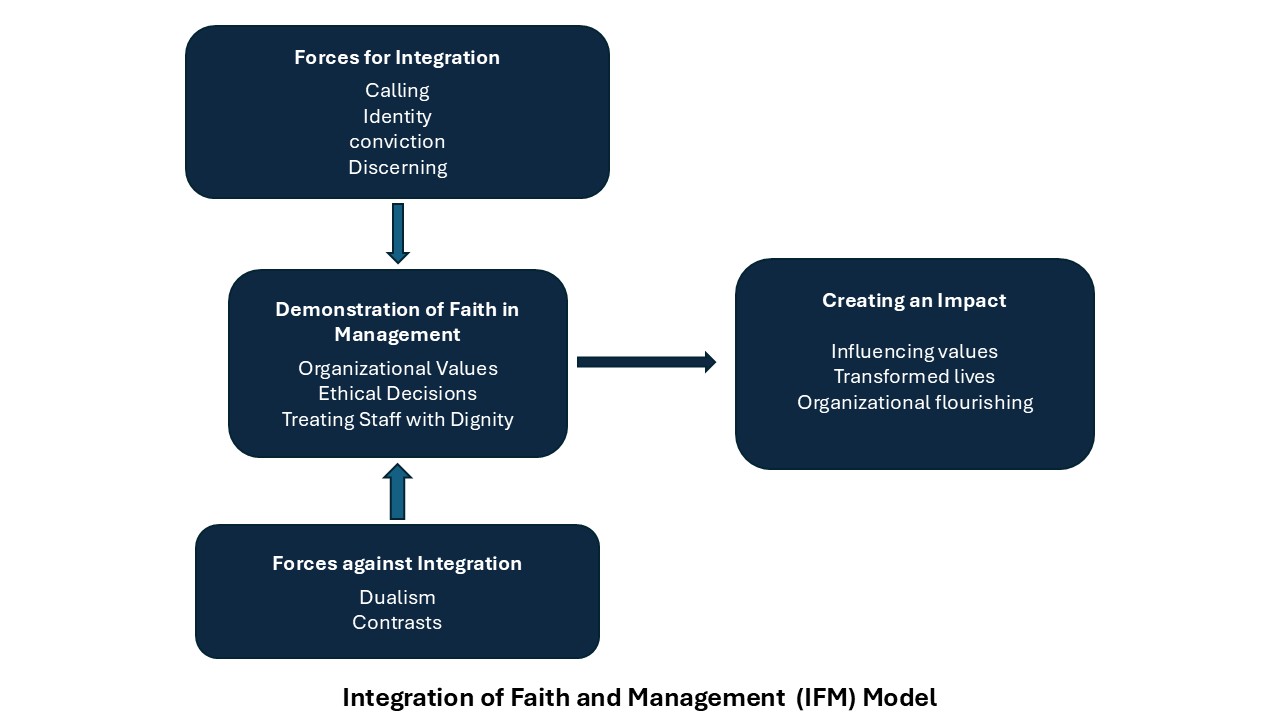
The data structure of our findings is provided in Figure 1. It showcases the aggregate dimensions, their corresponding second-order themes, and the first-order concepts. Four overarching dimensions emerged through this survey. Forces for integration, which answer the question ‘why would I integrate?’; forces against integration that answer the question ‘what prevents integration’; demonstration of the integration, that answers the question ‘how would I integrate?’; and creating an impact that would answer the question ‘what will happen if I integrate?’. Table 1 provides representative supporting data for each second-order theme. Further, the relationship between the dimensions is portrayed in Figure 2.
Forces for integration
This dimension consists of elements that positively influence integration. The analysis revealed themes such as calling, identity and conviction. Several participants indicated that they experienced a vocational calling to engage in business and viewed their professional lives as opportunities to contribute to society. Their identity in God led them to perceive their work as a form of ambassadorial service. Convictions grounded in faith-based values further motivated them to practice their beliefs in professional contexts. The process of discernment—understanding God’s will and distinguishing between right and wrong—also guided decision-making.
These themes align with existing scholarship on faith/work integration. For instance, Neubert & Dougherty (2015) found that the integration of faith and work enhances their attitude to work and contribute positively at work. Similarly, Lynn et al., (2010) identifies calling and identity as key components in work-faith integration.
Forces against integration
Participants also reported encountering forces that hinder integration. These included the desire to ‘win the game’ even at the expense of personal values, encounter with unethical market practices, and adherence to corporate metrics of success such as wealth, popularity, and status, which often conflict with biblical values of humility and compassion. Dualism emerged as an additional barrier, wherein individuals maintained one set of values in religious contexts and another at work.
The above two dimensions are in constant tension with each other. When the forces for integration are dominant, the possibilities of integrating one’s faith in management are higher and vice versa. . This observation mirrors findings in the existing knowledge regarding tension between external pressures and faith-based internal integrity (Cafferky, 2015). Moore (2017) also exhibits the conflicting nature of ‘external goods’ such as fame, reputation, money, and, ‘internal goods’ which are the pursuits of excellence.
Demonstration of integration
Once a manager overcomes the forces that are at work against integration, they demonstrate their faith through concrete practices. Examples include leaders choosing to forgo personal salaries during financial crises to ensure that staff were paid, resisting the acceptance or payment of bribes despite organizational costs, and consciously avoiding participation in inappropriate conversations or gossip in the workplace. These examples illustrate how convictions and faith-based identity shaped managerial and administrative practices.
This inference concurs with the position taken by Rodgers & Gago (2006) that ethical position (supported by Bible Scriptures) strongly influences the decision-making pattern in organizations. They portray that “there are several pathways to a decision, and the ethical position will strongly influence which pathway is taken.” Similarly, the research by Sorenson & Milbrandt (2023) reveals that family business owners rely on their family faith to sustain and establish ethical norms.
Creating an Impact
The integration of faith and management was found to have a significant impact. These included the transformation of individuals, positive influence on societal values, and overall organizational flourishing. Although there can be temporary setbacks, in the long run, these will be offset by high staff morale and goodwill, enabling the achievement of organizational objectives.
As noted earlier, scholars have found that the fruit of the Spirit in an organizational context is beneficial to workplace outcomes of employee engagement, job satisfaction, organizational commitment, and organizational spirituality (Dean, 2019). Similarly, the research by Sorenson & Milbrandt (2023) found evidence in their exploratory research that business families that rely on family faith to strengthen family social capital performed well in family leader succession, b) business performance, and c) community outreach.
Figure 1 – Data Structure
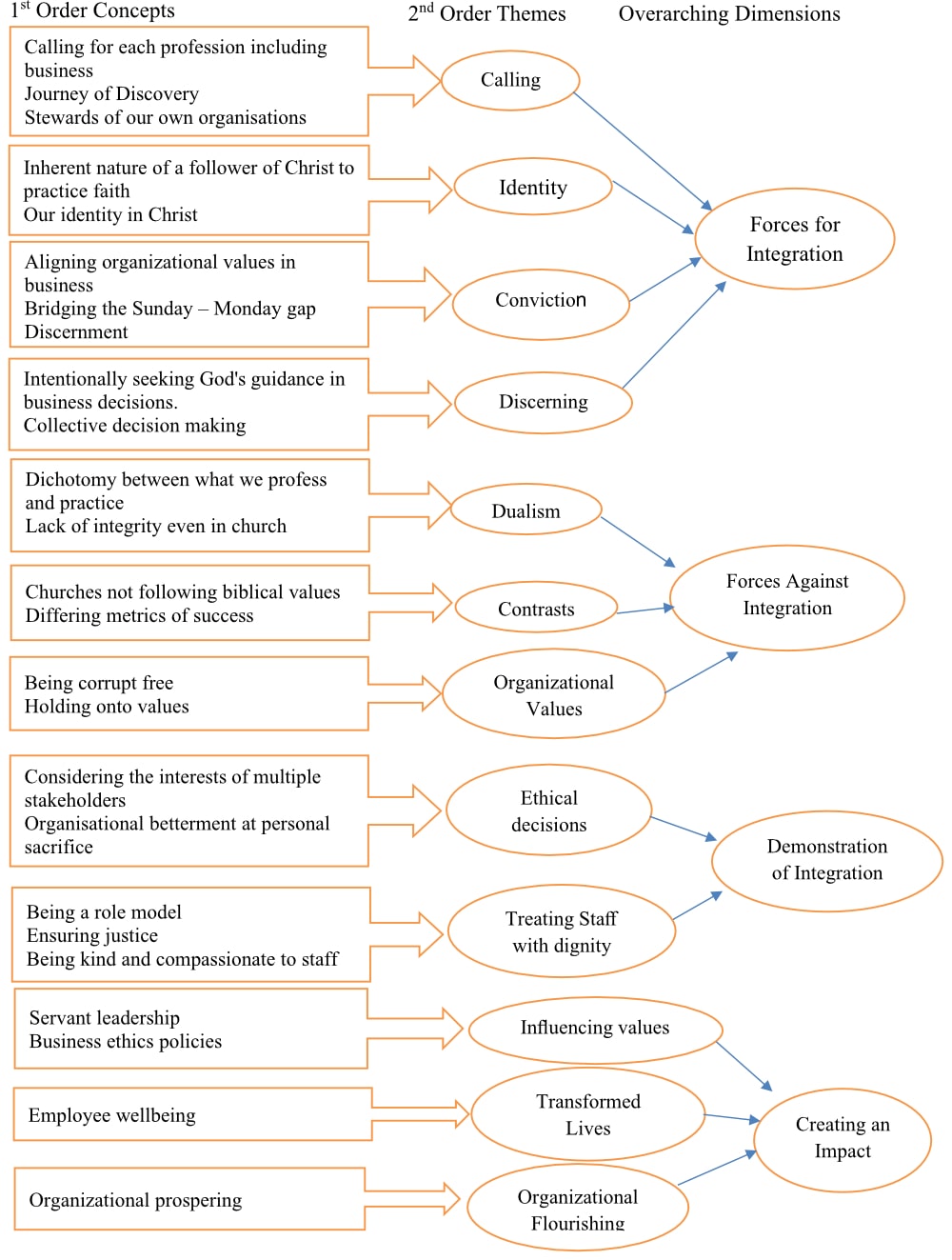
Table 1 – Representative Supporting Data for Each 2nd Order Theme
| 2nd Order Themes | Representative 1st Order Data |
|---|---|
| a. Calling | “I went to Bible school in the fall of 1964 intending to be involved in basketball missionary work… But the Lord called me instead to go into business.” “Integrating faith into business has been significant for me. It’s a journey of discovery and constant learning, though often fraught with challenges and failures.” “(our) business is a family-owned…, we seek to run it as stewards of a business that… ultimately belongs to God and not us.” |
| b. Identity | “All of life is an expression of our Christian faith, including the complexities of being a leader.” “It only makes sense that if the core of who I am is in my identity in Christ, then my management style would flow from who I am and how I operate.” |
| c. Conviction | “The organization values are very much aligned with the Biblical principles.” “The way that we are doing during Sunday services in church, this is the way that we should act from Monday to Saturday. It should be exactly the same.” |
| d. Discerning | “With my leadership team where we’ve waited on God. We’ve sought to discern together what God is saying to us…” “It’s critical that, that decision process not be done alone. It has to be started alone as you wrestle with the issue with the Lord… But you need to test that with your spouse if you’re married, with your partners if you’re in a business…” |
| e. Dualism | “When there is a contradiction… they’ll go others and say see he says one thing on the pulpit but does something else. You know he says big things in board meetings, but he does something very quickly.” “When I step into the soccer fields, my values, I leave outside the field because the most important thing for me is to win the game, you know, no matter what. If I have to kill my opponent, I’m gonna do that. exaggerating a little bit, but this might describe the way, the mindset of some Christians.” “Pity that people do not live what they preach.” |
| f. Contrasts | “I would say that even the church today needs a refocus on Christian basis of management because, while the secular world is silently aligning to Christian values, like ownership, I find that the opposite trajectory is taken by some Christian organizations.” “Popularity, wealth, influence, position, all of these … metrics that the world set is … indicators that you’ve been successful. Nobody preaches that you have to be humble, wash somebody’s feet, and have compassion.” |
| g. Organizational values | “That’s my budget per year, 45 million (USD). That’s a fortune in my country. So, I do lots of purchases. And of course, I don’t do bribery or corruption. But it’s very common at the market for the person who is buying things, the vendor, the contractor, the supplier, they may want to give you a gift, they may want to pay you a trip for you and your family, they may want to give you some commission…” “We do business with full integrity and the fear of God.” |
| h. Taking difficult decisions | “Because it was a separate business, we could simply have closed the company, burned off the creditors, and carried on with our main, our core business. But… we didn’t feel that was the right thing to do. We… felt, we needed (to) honor our debts and so we paid the debts out of the core business.” “As CFO, one of those responsibilities was mine to help the CEO rightsize the organization. And… that meant terminating people… When I was doing the evaluation, it became very clear that obviously the top-level echelons, CEO, COO, CFO, were the ones who were drawing the big paychecks. So, I said, listen, you need to terminate me.” |
| i. Treating staff with dignity | “As I invest in them, and then replicate the style, the mannerisms, the way of managing that they’ve seen in me, they’ve actually seen Jesus at work.” “I was looking through the payroll once, and I said, why are these people working this many hours, not being paid overtime, not having any benefits. They work 24/7, no vacation. I said, how is that fair?… We are going to compensate them adequately.” “Senior leader made the decision that even if we were not paid, we would make sure that our staff was paid because ultimately they were reliant on us.” |
| j. Influencing Values | “I am today in a secular organization… They don’t know that it has got biblical origins, but they do endorse and recommend servant leadership as the future way of sustainable leadership of organizations. |
| k. Transformed lives | “At the end of my tenure, I’ve had more of those level people continue to call me, send me email and all of this, because for the first time they felt that somebody had taken an interest in their wellbeing, had done something tangible for them and made a difference in their lives.” |
| l. Organizational flourishing | “Business… began to prosper again in subsequent years … I do believe that God honors in different ways (for) taking the right decision.” |
Based on these findings, the Integration of Faith and Management (IFM) Model is proposed (see Figure 2). This model demonstrates the dynamic interplay between the forces for and against integration. When the positive forces prevail, they lead to demonstrations of faith in management, which in turn contribute to organizational and societal impact. The IFM Model provides a conceptual framework for understanding faith integration in management and requires further validation through quantitative research.
Figure 2 – Integration of Faith and Management Model
Having noted the interest among both scholars as well as practitioners in having an intersection between faith and management, the next natural question is whether there are adequate avenues to publish this significant knowledge. Quite a few journals related to this niche area emerged in the last thirty years. They include the Journal of Biblical Perspectives on Leadership, the Journal of Biblical Integration in Business, the Journal of Applied Christian Leadership, the Scandinavian Journal for Leadership & Theology, the Journal of Religious Leadership, the Christian Business Academy Review, the Faith in Business Quarterly, the Journal of Virtues and Leadership, the International Journal of Servant Leadership, the Journal of Religion & Business Ethics, the Journal of Economics, Theology and Religion, the Journal of Management, Spirituality & Religion, the Christian Business Review Journal. However, the focus area of most of these journals is leadership and not management, and all these journals are being published from the global north. There is a thus a gap for a journal which also incorporates the diverse multi-cultural unique experiences of global south, that would add value to the Christian Management Research.
It is in this context that the Christian Institute of Management, in its silver jubilee year, is launching a new journal, the International Journal of Faith and Management (IJFM). This journal intends to provide a unique platform for publishing Christian value-based management research articles which will facilitate organizations, including churches, institutions, NGOs, business entities, and government undertakings to thrive amidst the multifarious contemporary challenges.
This multidisciplinary, peer-reviewed journal will produce quality literature on management, integrated with other disciplines such as theology, psychology, economics, and technology. The journal focuses on framing new models and constructs to be implemented in the workplace, for its flourishing (shalom). It gives a platform for academicians, researchers, and practitioners to publish their research articles offering alternative biblical management solutions. The journal will publish empirical and analytical research works, review articles, innovative concept papers and case studies. The manuscripts will cover topics including, but not limited to, governance, accountability, leadership, marketing, finance, human resources, entrepreneurship, organizational behaviour, resource mobilization, legal compliance, ethics, decision-making, and CSR.
The IJFM is unique on several counts. The journal is genuinely global as it addresses the managerial concerns of the global north and global south with a balance unlike most Western-centric journals. This dedication is evident both in the content and in the composition of its editorial and advisory boards. The balance is not just a token gesture, but a purposeful attempt to address the managerial issues of the global south to be effectively addressed. Managerial concerns of the developing nations pertaining to their MSMEs and NPOs can be researched and published in the IJFM, while the existing management-related journals focus on corporates from developed nations. Thus, the IJFM captures multiple voices and perspectives, presenting a holistic, globally informed knowledge of the subject. The relevance and application of the knowledge shared through the IJFM would increase further such studies.
The IJFM makes special efforts to satisfy the demands of practitioners and scholars alike. The journal would keep the rigour of scientific academic research and yet would generate application-oriented knowledge as a primary priority. The IJFM would provide ample inputs for practising managers to directly impact their managerial practices. IJFM helps academics and professionals apply their faith in the workplace. It does this by giving writers a forum to explore how to put their beliefs into practice in corporate and organizational settings, ultimately fostering a community dedicated to this purpose. Research articles based on case studies of the successful implementation of faith based novel theoretical models would empower practising managers. Thus, the IJFM articles as research outcomes will not remain in academic ivory towers but will serve professionals to strengthen and develop their managerial practices. The effective blend of theory and practice in the journal would invite widespread readers, viz., academics of management and theology, NPO managers, for-profit managers, and even government enterprise managers.
Management is a universally applicable art and science. Taylor (1911) stated that the fundamental principles of scientific management apply to all human activities, from individual acts to the work of large corporations. Koontz and O’Donnell (1955) believed that management fundamentals have universal application across all types of enterprises and at every level. Fayol (1949) defined management as involving forecasting, planning, organizing, commanding, coordinating, and controlling, seeing it as a universal science applicable to various fields like commerce, industry, and politics. Despite its universal application most journals focus on the profit oriented corporate aspects of management, neglecting its relevance to the service oriented NPOs. This has given rise to exclusive NPO focused journals as Nonprofit and Voluntary Sector Quarterly, Nonprofit Management and Leadership, Voluntas: International Journal of Voluntary and Nonprofit Organizations, etc. IJFM balances its focus on the management of profit-focused corporates and NPOs that exist to serve the community.
The focus of IJFM on Christian faith integrated into the practice of management is the final differentiator. This is a unique platform for exploring the influence of Christian values, principles, and theology on management practices. Some journals provide opportunities to examine the impact of all kinds of faith on management. The IJFM provides the opportunity to examine biblical concepts such as stewardship, servant leadership, compassionate leadership, moral decision-making, etc., to be applied to modern management issues. Christian faith as a lens for research deepens the discussion and examination of topics such as business purpose, employee well-being, corporate social responsibility. The journal aims to address the managerial decisions in different functional areas as influenced by Christian ideals.
IJFM is expected to thus produce significant knowledge at the intersection of faith and management, transforming the field of management. Kuyper’s (Henderson, 1992) famous quotation states, “There is not a square inch in the whole domain of our human existence over which Christ, who is sovereign overall, does not call out: ‘Mine!” This includes the enterprises and institutions, both for-profit and not-for-profit. How pleasant it will be if the management of these institutions is conducted in a way that glorifies the God of the universe.
We aim to bring radiance and fragrance to the field of management through the publication of the IJFM. We invite scholars and practitioners from across the globe to read, critique, publish, and actively engage with this journal towards this end.
References
Alexandar, A., Phillips Prasad, & Samuel, R. (Eds.). (2022). Christian Management in a VUCA World: Reflections from a Global Pandemic Context. Christian Institute of Management.
Cafferky, M. E. (2012). Management: A Faith Based Perspective Pearson.
Cafferky, M. E. (2015). Religious beliefs, models of faith integration at work, and the role of organizational culture. Journal of Biblical Integration in Business, 18(1), 35–52. https://www.researchgate.net/publication/281784330_Religious_Beliefs_Models_of_Faith_Integration_at_Work.
Chewning, R. C. (1995). The Challenge: To Impregnate Business Teaching with Biblical Perspective. Journal of Biblical Integration in Business, 6-8.
Chewning, R. C. (1998). Biblical Orthodoxy Requires the S.N.A.P. of Scripture. Journal of Biblical Integration in Business, 78-93.
Dean, D. J. (2019). Integration of Christian Values in the Workplace. Journal of Biblical Perspectives in Leadership, 1(1), 35–55.
Dyck, B. (2020). Theological underpinnings and outcroppings in Organization and Management Theory. In S. Schwarzkopf (Ed.), The Routledge Handbook of Economic Theology (pp. 195–202). Routledge. https://doi.org/10.4324/9781315267623
Dyck, B., & Wiebe, E. (2012). Salvation, theology and organizational practices across the centuries. Organization, 19(3), 299–324. https://doi.org/10.1177/1350508412437073
Dupree, J. (2025). Biblical Integration into business in the JBIB: A review of 20 years of the development of the concept of faith integration. Journal of Biblical Integration into Business, 18(2), 89-102.
Fayol, H. (1949). General and industrial management (C. Storrs, Trans.). Sir Isaac Pitman & Sons.
Franz, R. S. (2014). An Exercise in Theological Imagination: Missing Constructs and Management Implications. Journal of Biblical Integration in Business, 17, 43-58.
Heintzman, P. (2015). Implications for the Leisure of Business People from a Review of the Biblical Concept of Sabbath and Rest. Journal of Biblical Integration into Business, 9-19.
Henderson, R. D. (1992). How Abraham Kuyper Became a Kuyperian. Christian Scholar’s Review, xxii(1), 22–35.
Hoag, G. G., Roddin R. S., & Willmer, W. K. (2015). The Choice. ECFA Press.
Koontz, H., & O’Donnell, C. (1955). Principles of management: An analysis of managerial functions. McGraw-Hill.
Logue, N. C. (1998). Dialogue I: A Response to Brian E. Porter’s “The Compatibility of Christianity and Business”. Journal of Biblical Integration in Business, 22-25.
Lynn, Monty L, Naughton, Michael J, & VanderVeen, Steve. (2010). Connecting religion and work: Patterns and influences of work-faith integration. Human Relations, 64(5), 675–701. https://doi.org/10.1177/0018726710386396
Moore, G. (2017). Virtue at Work: Ethics for Individuals, Managers, and Organizations. Oxford University Press. https://doi.org/10.1093/oso/9780198793441.001.0001
Neubert, M. J., & Dougherty, K. D. (2015). Integrating Faith and Work. Institute for Faith and Learning.
Oberholster, B. (1993). Management—A Christian Perspective. December, 229–243.
Patterson, K. (2003). Servant Leadership: A Theoretical Model.. http://www.regent.edu/acad/sls/publications/conference_proceedings/servant_leadership_roundtable/2003pdf/patterson_servant_lead
Pio, E., Kilpatrick, R., & Pratt, T. (2021). Reimagining faith and management — the impact of faith in the workplace (E. Pio, R. Kilpatrick, & T. Pratt, Eds.; 1st ed.). Routledge. https://doi.org/10.4324/9781003041733
Porter, B. E. (1998). A Response to “Biblical Orthodoxy Requires the S.N.A.P. of Scripture”. Journal of Biblical Integration in Business, 103-108.
Rodgers, W., & Gago, S. (2006). Biblical Scriptures Underlying Six Ethical Models Influencing Organizational Practices. Journal of Business Ethics, 64(2), 125–136. https://doi.org/10.1007/sl0551-005-0657-7
Smith, Y. S. (2010). Three Myths of Good Hard Work. Journal of Biblical Integration in Business, 13, 87- 99.
Sorenson, R. L., & Milbrandt, J. M. (2023). Family Social Capital in Family Business: A Faith-Based Values Theory. Journal of Business Ethics, 184(3), 701–724. https://doi.org/10.1007/s10551-022-05110-4
Stephen P. Robbins, David A. Decenzo, & Mary Coulter. (2013). Fundamentals of Management: Essentials Concepts and Applications (8th Edition). Pearson. www.mymanagementlab.com
Taylor, F. W. (1911). The principles of scientific management. Harper & Brothers.