A Bibliometric Mapping of Spiritual Foundation Management and Faith-Inspired Leadership on Organizational Effectiveness
Abstract
This bibliometric analysis explores the intersection of spirituality and organizational management by examining the impact of religious faith-based biblical influences on leadership and effectiveness within various contexts. The study systematically maps the existing literature using bibliometric methods and “Visualization of Similarities, VOSviewer” network analysis to reveal insights into key themes, trends, and influential works.
By synthesizing a wide range of scholarly publications, the research deepens our understanding of how spiritual foundations shape organizational leadership and effectiveness. It highlights theoretical frameworks, practical applications, future research directions, and managerial practices in diverse settings.
This analysis serves as a valuable resource for scholars, practitioners, and policymakers interested in the interplay between spirituality and effective organizational management.
Keywords: Spirituality in Management, Faith-Based Leadership, Biblical Influences on Organizational Effectiveness, Bibliometric Analysis, VOSviewer.
Introduction
In contemporary organizational scholarship, the intersection of spirituality and management has emerged as a compelling area of inquiry. The recognition of the profound impact of religious, faith-based, and biblical principles on organizational leadership and effectiveness has led to a growing body of literature. “Spiritual Foundation Management” refers to the integration of religious, faith-based, or spiritually grounded principles particularly Christian values into leadership and organizational practices to foster ethical decision-making, holistic well-being, and purpose-driven performance. Despite increasing attention in recent years, a clear synthesis of the research trends, key contributors, and thematic directions in this domain remains underexplored particularly in the context of faith-inspired leadership within Indian and global settings. This paper addresses this significant gap through a comprehensive bibliometric analysis, identifying influential authors, key journals, and emerging themes that shape the landscape of spiritual foundation management. It does this by meticulously examining publication and citation patterns, assessing the impact of contributions from leading authors and mapping the co-occurrence of terms This study aims to provide a nuanced understanding of the scholarly landscape and offers crucial and valuable insights for both future academic inquiry and practical managerial applications.
Methodology
The dataset for this bibliometric analysis was systematically constructed from comprehensive academic databases, including, but not limited to PubMed, Scopus and Web of Science. The search terms encompassed a broad spectrum of topics related to spirituality, religion, faith-based practices, and organizational management. The temporal scope of the analysis spanned publications from 1990 to 2023, ensuring a robust overview of the scholarly evolution within this field.
Inclusion criteria focused on articles, journals, and authors that directly addressed the intersection of spirituality, faith, leadership and organizational effectiveness. To ensure scholarly rigor, exclusion criteria was adopted to exclude materials, such as opinion pieces, non-peer-reviewed publications and duplicates.
The bibliometric analysis was conducted using established methods, including bibliographic coupling to identify intellectual communities, and co-occurrence analyses for mapping key themes and concepts. Network analysis, facilitated by VOSviewer software, was employed to visualize and interpret the relationships among influential journals, authors and co-occurring terms. Further, the publication and citation structures over time were meticulously examined to delineate trends, identify periods of heightened scholarly activity and highlight the impactful contributions within the field.
Review of Literature
Spirituality in Management
Ashmos, D. P., & Duchon, D. (2000). This article focuses on the conceptualization and measurement of spirituality at work, proposing a model for understanding and assessing spirituality in organizational settings. Their research was undertaken in the United States, with data collected across various organizations and employees. It emphasizes the importance of integrating spirituality into the workplace and highlights the potential benefits for both employees and organizations. The authors posit that spirituality at work encompasses a profound sense of community, meaning, and shared values that contribute significantly to employees’ well-being and performance. They propose a multidimensional model for measuring spirituality in the workplace; comprising personal spiritual development, organizational spiritual values and a sense of community. The study concludes that fostering these elements within an organization can enhance employee satisfaction, engagement and overall organizational effectiveness.
Mitroff, I. I., & Denton, E. A. (1999). A pioneering study was conducted in the United States that examines the intricate relationships among workplace spirituality, organizational culture and employee performance. Additionally a comprehensive survey of employees across various organizations provides data to explore potential connections. The analysis focuses on how workplace spirituality might be associated with key employee factors such as job satisfaction, organizational commitment and performance. Additionally, it investigates how fostering a culture that integrates employees’ sense of purpose and meaning (often referred to as workplace spirituality) might relate to employee engagement and satisfaction. The findings aim to significantly contribute to the ongoing discussion on whether promoting workplace spirituality, potentially through leadership that aligns with employee values, could be a factor in strengthening organizational culture and effectiveness.
Fry, L. W., Vitucci, S., & Cedillo, M. (2005). They examined the impact of spiritual leadership on organizational transformation. The research was carried out in the United States, with a focus on the U.S. Army. Their study introduces a theoretical framework for understanding spiritual leadership and proposes a model for measurement. The findings indicate that spiritual leadership is positively associated with organizational commitment and productivity by fostering intrinsic motivation along with creating a vision that aligns with both the personal and the organizational values that cultivate a sense of community bonding. The authors suggest that organizations can promote spiritual leadership practices that facilitate a culture of shared values, altruistic love, hope and faith to positively influence employee well-being leading to improved engagement, organizational effectiveness and successful transformation.
Fry, L. W. (2003). Louis W. Fry developed the theory of spiritual leadership emphasizing the critical role of values, vision, and meaning in leadership practices while integrating intrinsic motivation and spiritual well-being to enhance organizational outcomes. It proposes a conceptual framework for understanding spiritual leadership and its impact on organizational effectiveness. The study suggests that spiritual leadership is characterized by its focus on serving others, cultivating a strong sense of community, promoting shared values and meaning. Such Leadership is argued to lead to increased organizational commitment, employee engagement and productivity as spiritual leaders are more likely to inspire and motivate their followers.
Cunha, M. P., & Rego, A. (2006). This study explores the relationship between different dimensions of organizational climate such as leadership style, communication practices, emotional intelligence, influence, employee attitude, organizational commitment and performance in the banking industry in Portugal. It presents findings from a survey of bank employees and discusses the implications for leadership development and organizational effectiveness. The findings suggest that a positive organizational climate characterized by supportive leadership, open communication channels and adequate resources fosters higher levels of job satisfaction as well as commitment among employees which in turn can lead to efficacy and customer satisfaction.
These studies collectively underscore the transformative potential of spiritual principles in shaping organizational culture and individual behavior. However, there is a need to critically examine how these concepts translate across diverse socio-cultural contexts and management structures.
Faith-Based Leadership
Barbuto, J. E., Jr., & Wheeler, D. W. (2006). The article focuses on the development of a scale to measure servant leadership, a form of faithbased leadership that emphasizes serving others. It presents findings from a survey of employees and discusses the implications for leadership development. The researchers identified three primary leadership styles namely Transformational, Transactional and Laissez-faire. Transformational leadership inspires and motivates employees to rise beyond their expectations while transactional leadership focuses mainly on setting clear goals as well as rewarding them. Laissez-faire leadership is characterized by minimal involvement from the leaders. The findings indicate a positive correlation between the Transformational Leadership and Organizational commitment among employees. The findings of Barbuto and Wheeler contribute to understanding the dynamics of leadership and organizational commitment. They suggest that organizations can benefit from developing leaders who prioritize serving others and fostering a sense of community.
Sosik, J. J., & Godshalk, V. M. (2000). This study investigates how the relationship between leadership styles, mentoring functions affect job-related stress in the United States. It proposes a conceptual model and presents preliminary findings from a survey of employees. The results of the study indicate a positive correlation between the transformational leadership and the mentoring functions received and the negative correlation between the transformational leadership and job-related stress. This suggests that transformational leaders are more likely to provide support and guidance to their followers. The findings significantly suggest that transformational leadership can help reduce job-related stress and enhance job satisfaction. They also highlight the importance of mentoring in leadership development and organizational effectiveness.
Sosik, J. J., & Jung, D. I. (2010). This book explores the concept of full-range leadership development which encompasses transformational, transactional, and laissez-faire leadership styles from various organizations worldwide. It presents case studies and practical strategies for developing effective leaders. The book highlights the importance of developing leaders who can adapt their leadership style to different situations. It argues that full-range leadership development can lead to improved employee engagement, organizational effectiveness, and sustainability. The findings suggest that organizations can benefit from investing in leadership development programs that focus on developing a range of leadership styles. This can help them address various challenges and opportunities.
Sosik, J. J., & Megerian, L. E. (1999). This study examines the relationship between leader emotional intelligence and employee performance in the United States. It presents findings from a survey of employees and discusses the implications for leadership development and organizational effectiveness. The study finds that leader emotional intelligence is positively associated with transformational leadership and employee performance. It also suggests that leaders with higher emotional intelligence are more likely to be perceived as effective by their followers. The findings suggest that organizations can benefit from promoting emotional intelligence among their leaders. This can lead to improved leadership effectiveness, employee performance, and organizational outcomes.
While faith-based leadership aligns closely with transformational and servant leadership styles, it differs significantly in its explicit grounding in religious doctrine. Unlike servant leadership which draws from moral and ethical ideals in a broad sense, faith-based leadership is shaped by religious convictions. This makes it potentially powerful in faith-aligned institutions but also raises questions about its applicability and inclusiveness in secular or multicultural workplaces. These distinctions deserve deeper inquiry within future studies.
Biblical Influences on Organizational Effectiveness
Canwell, A., & Sutherland, J. (2014). This book explores various leadership theories and their practical applications from various organizations worldwide in the 21st century. It presents case studies and practical strategies for developing effective leaders. The book highlights the importance of understanding different leadership theories and their implications for organizational effectiveness. It argues that leaders who can adapt their leadership style to different situations are more likely to be effective. The findings suggest that organizations can benefit from investing in leadership development programs that focus on developing a range of leadership styles. This can help them address various challenges and opportunities.
Hoyle, L. H., & Wallace, J. E. (2005). This study examines the changing nature of work and its impact on the design of managerial jobs in Canada. It presents findings from a survey of managers and discusses implications for leadership development and organizational effectiveness. The study finds that the changing nature of work is associated with increased job demands and challenges for managers. It suggests that organizations need to adapt their work design to the evolving needs and expectations of their employees. The findings suggest that organizations can benefit from rethinking the design of managerial jobs to better align with the changing nature of work. This can lead to improved employee satisfaction, engagement and organizational effectiveness.
Bakker, A. B., & Demerouti, E. (2007). This paper presents an overview of the job demands-resources (JD-R) model, a framework that underscores the critical role of job demands and resources in predicting both job performance and employee well-being within organizations in the Netherlands. It discusses the significant implications for leadership development and organizational effectiveness. The JD-R model highlights the importance of job demands and resources in predicting job performance and well-being. It suggests that organizations need to manage job demands and resources effectively to promote employee well-being and organizational effectiveness. The findings suggest that organizations can benefit from adopting the job demands-resources model to enhance employee well-being and organizational effectiveness. This can be achieved through strategic application of effective leadership practices and organizational policies.
Coyle-Shapiro, J. A.-M., & Conway, N. (2004). This chapter examines the employment relationship through the lens of social exchange theory in the United Kingdom. It presents findings from various studies and discusses implications for leadership development and organizational effectiveness. The chapter highlights the importance of social exchange theory in understanding the employment relationship and its implications for organizational effectiveness. It suggests that organizations need to foster a positive exchange between employees and the organization to promote engagement and commitment. The findings suggest that organizations can benefit from adopting social exchange theory to understand and manage the employment relationships. This can lead to increased employee engagement, commitment, and organizational effectiveness.
The incorporation of biblical values such as humility, stewardship and servant leadership presents a compelling model for organizational practice. However, adapting these principles in multicultural or non-Christian contexts presents practical challenges. Future research can explore how biblical frameworks can be contextualized or integrated with secular leadership approaches in inclusive ways that respect diverse workplace environments.
This study utilized VOSviewer for network visualizations, including co-occurrence mapping, bibliographic coupling and author-country clustering. The following thresholds were applied: a minimum of three documents per source, two publications per author, and five documents per country. These settings allowed the identification of key themes and collaborative patterns while ensuring the data set’s integrity and interpretability. VOSviewer’s ability to detect clusters based on link strength was instrumental in uncovering relationships across authors, journals and countries.
Data
The dataset has been extracted from Dimensions. In search criteria the keywords — “Christian faith theory” OR “Christian Spirituality principles” OR “Religious management” OR “Spiritual application in management” OR “Faith-based leadership” OR “Christian faith in India” OR “Indian spirituality principles” OR “Religious management in India” OR “Spiritual application in Indian organizations” OR “Christian Faith-based leadership in the Indian context” OR “Biblical principles in Indian management” OR “Indian Christian spirituality and business” OR “Religious influence on management in India” OR “Faith-based organizations in India” OR “Spiritual factors in decision-making in an Indian setting” OR “Christian ethics in Indian business” OR “Faith-driven leadership in the Indian workplace” OR “Indian perspectives on biblical leadership” OR “Spiritual principles and organizational behaviour in India” OR “Religious and managerial effectiveness in the Indian context” OR “Indian Christian worldview in management” OR “Biblical perspectives on leadership in the Indian context” OR “Faith and workplace culture in India” OR “Spiritual guidance in Indian management” OR “Religious values in organizational development in India” OR “Faith and sustainability management” OR “ Management, Spiritual and Religion” occurring at any of the places Article Title, Abstract or Keywords have been applied.
The Dimensions database returned 768 matches because of this search (shown in Table 1). This resulted in the dataset for doing studies in the field of “Faith-Based Management” or “Spiritual Leadership in Organizational Contexts,” with a focus on Christian perspectives, principles and practices.
| Title, Abstract or Keyword | |
| “Christian faith theory” OR “Christian Spirituality principles” OR “Religious management” OR “Spiritual application in management” OR “Faith-based leadership” OR “Christian faith in India” OR “Indian spirituality principles” OR “Religious management in India” OR “Spiritual application in Indian organizations” OR “Christian Faith-based leadership in the Indian context” OR “Biblical principles in Indian management” OR “Indian Christian spirituality and business” OR “Religious influence on management in India” OR “Faith-based organizations in India” OR “Spiritual factors in decision-making in an Indian setting” OR “Christian ethics in Indian business” OR “Faith-driven leadership in the Indian workplace” OR “Indian perspectives on biblical leadership” OR “Spiritual principles in organizational behaviour in India” OR “Religious and managerial effectiveness in the Indian context” OR “Indian Christian worldview in management” OR “Biblical perspectives on leadership in the Indian context” OR “Faith and workplace culture in India” OR “Spiritual guidance in Indian management” OR “Religious values in organizational development in India” OR “Faith and sustainability management” OR “ Management, Spiritual and Religion” | |
| Article | 390 |
| Chapter | 133 |
| Monograph | 132 |
| Edited Book | 99 |
| Preprint | 8 |
| Proceedings | 6 |
| Total | 768 |
Source: This dataset has been extracted from Dimensions on 2 February 2024.
Results
The results have been discussed in the following two subsections: publication and citation structure, and analysis of publications of leading authors.
Publication and Citation Structure
Figure 1 illustrates the cumulative number of publications pertaining to both Faith-Based Management and Spiritual Leadership in Organizational Contexts. Figure 1 also highlights the number of publications in the field over the years, indicating a notable trend in the growth of literature on the intersection of spirituality and organizational management.
Figure 1
Annual Number of Publications in the Field of Faith-Based Management and Spiritual Leadership
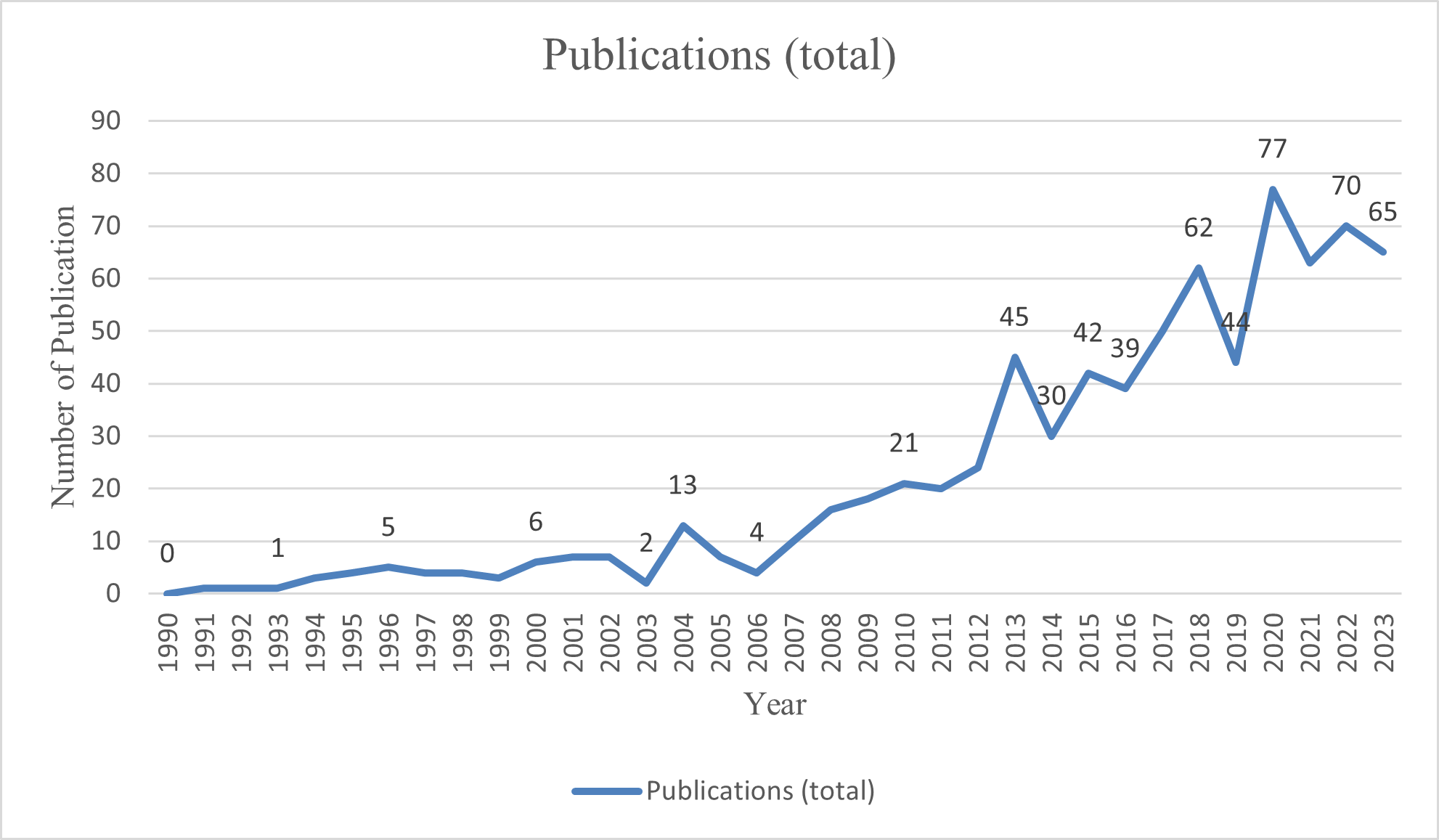
The data begins with no recorded publications in the early 1990s, but a gradual increase is observed, with one or two publications per year in the early 1990s and 2000s. A steady rise in the number of publications began from the mid-1990s onwards, with significant momentum from the early 2000s. The remarkable surge is observed in recent years, particularly from 2018 onwards with a substantial increase in the number of publications. This suggests a growing interest and research activity in the area of spirituality and organizational management.
The spike in publications from 2018 to 2022 indicates a period of intensified scholarly focus on this topic. The high numbers in recent years could be attributed to increased awareness, evolving perspectives, and possibly an acknowledgment of the significance of spirituality in organizational leadership and management effectiveness.
The overall trend suggests that the interplay of spirituality and organizational management has become an increasingly prominent area of research and study, with a notable surge in publications in the last decade. This growth reflects a heightened interest and recognition of the relevance of spirituality in shaping contemporary discussions on effective organizational management.
Top 10 Leading Authors
An analysis of the top 10 leading authors in the field was conducted based on publication output and citation impact. The results have been summarized in Table 2.
Table 2 – Top 10 Authors and their Citations
| Name, Organization, Country | Publications | Citations | Citations mean |
|---|---|---|---|
| Lotem Perry-Hazan University of Haifa, Israel | 9 | 114 | 12.67 |
| Samta P Pandya Tata Institute of Social Sciences, India | 4 | 6 | 1.5 |
| Christine L Cunningham, Edith Cowan University, Australia | 3 | 8 | 2.67 |
| Khalid Husny Arar Texas State University, United States | 3 | 6 | 2 |
| Rania Sawalhi, Qatar University, Qatar | 3 | 6 | 2 |
| Michelle Striepe Edith Cowan University, Australia | 3 | 8 | 2.67 |
| Carrie L Woods University of Puget Sound, United States | 3 | 67 | 22.33 |
| Yoshiko Ashiwa Hitotsubashi University, Japan | 3 | 60 | 20 |
| David Lehmann University of Cambridge, United Kingdom | 3 | 37 | 12.33 |
| Diane Hess-Hernandez Regent University, United States | 2 | 3 | 1.5 |
Lotem Perry-Hazan, University of Haifa, Israel emerges as the leading author in terms of both the number of publications and citations. With nine publications and an impressive citation mean of 12.67, this indicates a substantial impact of their work within the field of spirituality and organizational management.
Samta P Pandya, Tata Institute of Social Sciences, India has contributed significantly with four publications. While the number of citations is comparatively lower, their work still holds relevance with a citation mean of 1.5.
Christine L Cunningham, Edith Cowan University, Australia is recognized for three publications, and their work has garnered eight citations, resulting in a citation mean of 2.67.
Khalid Husny Arar, Texas State University, United States has three publications with six citations, leading to a citation mean of 2.0.
Rania Sawalhi, Qatar University, Qatar has three publications and her work has received six citations, resulting in a citation mean of 2.0.
Michelle Striepe, Edith Cowan University, Australia has contributed three publications with a citation mean of 2.67.
Carrie L Woods, University of Puget Sound, United States stands out with an impressive citation mean of 22.33, indicating a high impact of her work with three publications.
Yoshiko Ashiwa, Hitotsubashi University, Japan has three publications and a substantial citation mean of 20, highlighting the impact of her contributions.
David Lehmann, University of Cambridge, United Kingdom has three publications with a citation mean of 12.33.
Diane Hess-Hernandez, Regent University, United States has two publications with a citation mean of 1.5.
In summary, the identified top 10 authors have made significant contributions to the burgeoning field of spirituality and organizational management. Their diverse research, as evidenced by publication and citation numbers, has been instrumental in shaping the theoretical underpinnings and empirical understanding of this area.
Network Analysis using VOSviewer
In the following subsections, network analysis of co-occurrence, bibliographic coupling of sources and authors have been carried out.
Analysis of Co-occurrence
Co-occurrence analysis delves into the intricate dynamics surrounding religion, governance, and education, uncovering thematic clusters that provide insights into the multifaceted intersections of these domains. The resulting image has been shown in Figure 2.
Figure 2 – Network Visualization of Co-occurrence
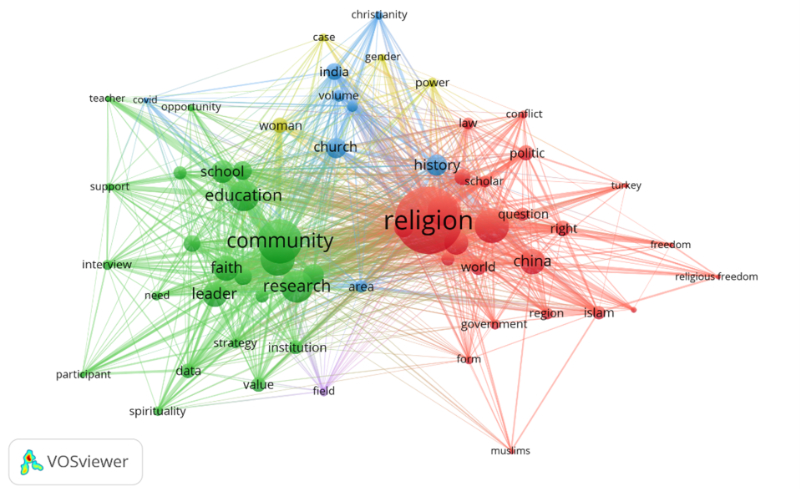
Each cluster has been identified by a theme the description of which is given below:
Cluster 1: Governance and Societal Dynamics (Red)
This cluster includes terms related to governance, politics, and societal dynamics. It encompasses terms like government, politic, policy, country and region. The presence of terms such as religious freedom and China suggests a focus on the intersection of religion, politics and governance, particularly in regions like China and Turkey. It appears to be a cluster highlighting the influence of political and governance structures on religious freedom and practices.
Cluster 2: Educational Context and Leadership (Green)
This cluster revolves around terms associated with education, leadership, and community. It includes terms such as education, teacher, student, school, leadership and community. The co-occurrence of terms like faith, spirituality and value within this cluster indicates a connection between educational environments, values and spiritual aspects. The cluster suggests a focus on the role of education, leadership and community in shaping values and spirituality.
Cluster 3: Cultural and Religious Context (Blue)
This cluster comprises terms related to cultural and religious contexts, including Christianity, church, India and history. The co-occurrence of terms like covid and history suggests a potential exploration of the impact of historical events, including the COVID-19 pandemic, on religious and cultural dynamics.
Cluster 4: Gender and Power Dynamics (Yellow)
This cluster is characterized by terms related to gender and power dynamics, such as gender, power and women. It implies a focus on the intersection of religion, gender, and power dynamics, exploring how these factors influence each other.
Cluster 5: Academic and Research Focus (Purple)
This cluster includes terms related to academic and research activities, such as field, area, case and research. It suggests a focus on the academic exploration of religious, cultural, and societal phenomena, including case studies and research in these areas.
In summary, the clusters reveal a multidimensional exploration of the intersection of religion, governance, education, culture, gender and academia. Each cluster represents a thematic grouping of terms that co-occur, indicating potential areas of emphasis and research focus within the broader context of the analyzed terms.
Bibliographic Coupling of Sources
This analysis examines the bibliographic coupling between academic sources (journals), where the strength of coupling increases with the number of shared references between their publications. For this study, only sources with a minimum of three publications were included. Notably, the citation count for individual publications was set to the default value of zero for this specific analysis.
Applying these criteria, 22 relevant sources were obtained. For each of these sources, VOSviewer was utilized to calculate the total link strength (TLS) of their bibliographic coupling links. The sources in the final graph are selected based on total link strength (TLS).
In Figure 3, the proximity of nodes (representing sources) indicates a higher degree of cocitation among their publications.
Figure 3 – Bibliographic Coupling of Journals or Sources
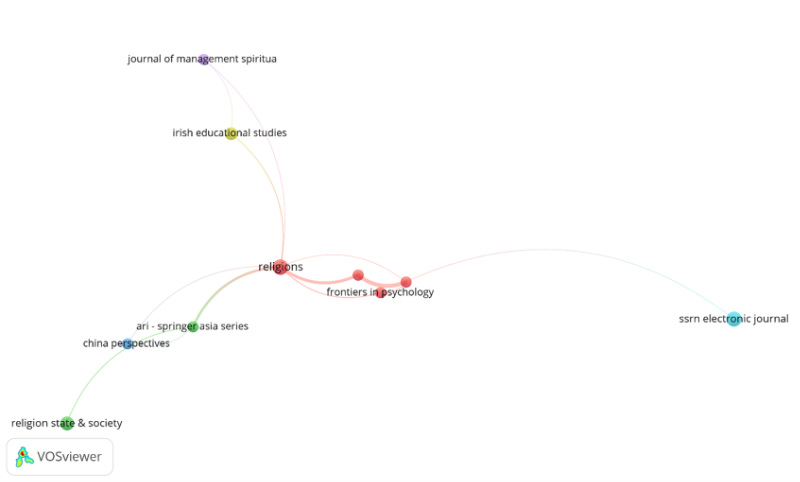
Cluster 1 reflects a thematic grouping of journals with a focus on the intersection of educational psychology and religion. Journals such as Frontiers in Psychology, International Journal of Qualitative Studies in Education and Journal of Education Administration show bibliographic coupling indicating shared references and common themes. The inclusion of Religions with a higher number of documents suggest a comprehensive exploration of the intersection between religion and educational psychology within this cluster.
Cluster 2 highlights journals with a focus on Asian perspectives on religion and society. The ARI – Springer Asia Series and Religion, State & Society exhibit bibliographic coupling, suggesting a shared scholarly focus. The higher number of documents in Religion, State & Society indicate a substantial exploration of the relationship between religion and societal structures in Asian contexts.
Cluster 3 focuses specifically on China Perspectives, indicating a thematic concentration on publications related to China. The bibliographic coupling suggests common references and shared research interests within this journal.
Cluster 4 centres around Irish Education Studies showcasing a bibliographically coupled group. The presence of shared references and themes suggest a concentrated exploration of educational studies specific to Ireland.
Cluster 5 emphasizes the Journal of Management, Spirituality & Religion, with strong bibliographic coupling. The high number of links and link strength signifies a dense network of shared references, indicating a substantial scholarly intersection between management, spirituality and religion.
Cluster 6 focuses on the SSRN Electronic Journal, representing a diverse repository of social science research. The high link count and link strength indicate a significant overlap in referenced sources, suggesting a broad spectrum of research interests within this electronic journal.
These interpretations provide an overview of the thematic concentrations and shared scholarly interests within each cluster that is based on bibliographic coupling of sources.
Bibliographic Coupling of Authors
To conduct this analysis, the minimum number of documents published by an author was set by the default value of 2 and the minimum number of citations for a publication was set to the default value of 0. Out of 1052 authors, 17 authors met these specified criteria. The results of this analysis have been visually represented in Figure 4.
Figure 4 – Bibliographic Coupling of Authors
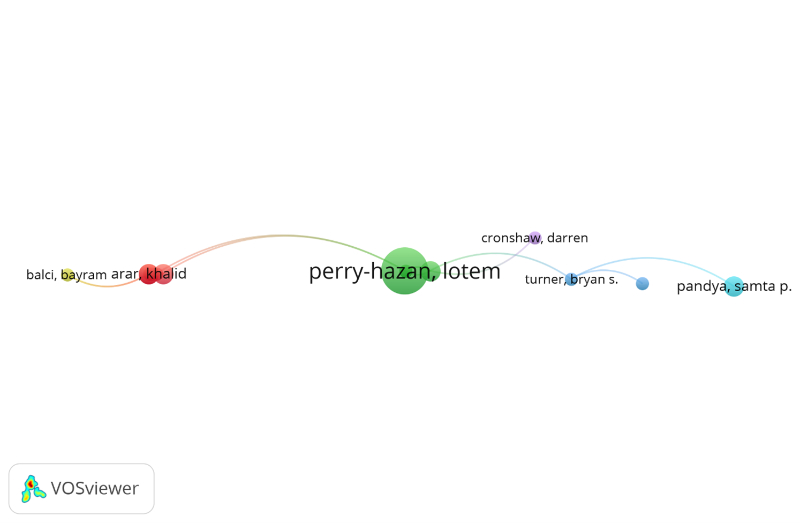
The authors in these analyses have been clustered into 6 groups.
Cluster 1 comprises a group of researchers with a focus on education and leadership studies. The cluster includes Arar, Khalid, Brooks, Jeffrey S., Brooks, Melanie C., among others and their grouping suggests a collaborative or interconnected research network in the field of education and leadership.
Cluster 2 consists of authors contributing to research on religion and society. Barak-Corren, Netta, Lehmann, David, and Perry-Hazan, Lotem, are grouped together, indicating potential collaborations or shared interests in the intersection of religion and societal dynamics.
Cluster 3 represents scholars from sociology, the inclusion of Lim, Francis Khek Gee and Turner, Bryan S. which suggests a bibliographic coupling in the field of sociology that is potentially focusing on cultural and societal aspects.
Cluster 4 comprises Bayram Balci as an individual researcher. This cluster suggests a unique research focus or less interconnectedness with other authors in this trajectory.
Cluster 5 focuses on Darren Cronshaw, indicating a distinct research focus, potentially in the area of management and spirituality. The lack of other authors in this cluster suggests a more independent research trajectory.
Cluster 6 includes Samta P. Pandya, highlighting an individual scholar potentially working in the broader field of social sciences. This cluster suggests a distinct research trajectory. These interpretations provide insights into the collaborative networks and shared research interests among authors within each cluster based on bibliographic coupling.
Bibliographic Coupling of Countries
For this analysis, the default thresholds for the minimum number of documents and citations for a country were retained at 5 and 0, respectively. Out of the 55 countries considered in the dataset, 23 countries met these thresholds. The results of this analysis are illustrated in Figure 5.
Figure 5 – Density Visualization on Bibliographic Coupling of Countries
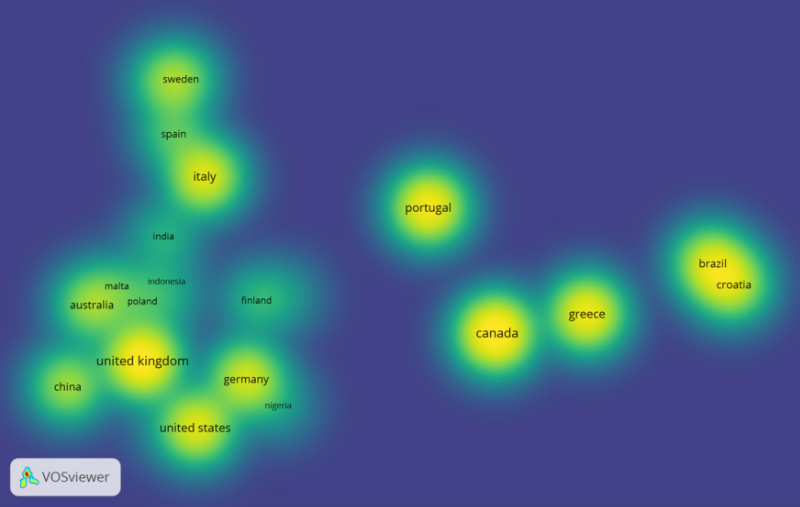
Cluster 1 includes Australia, Finland, India, Poland, Malta, Turkey, Indonesia and Belgium, that is characterized by moderate to low citation and document totals indicating smaller but potentially focused research efforts.
Cluster 2, comprising of the United Kingdom, the United States, Germany, China, Nigeria, and Switzerland feature high document and citation numbers that reflect robust research hubs and widespread research activities.
Cluster 3 includes Canada, Portugal, Greece, Brazil and Croatia showing significant but not as extensive research output and collaboration as Cluster 2.
Cluster 4, features Italy, Sweden, Spain and Ireland which exhibits varied document totals and citation strengths suggesting specialized research areas or emerging collaborations.
Canada, in Cluster 3, shows a strong link strength relative to its document total, indicating influential research with significant cross-references. The United Kingdom in Cluster 2, has a high document total and substantial link strength, reflecting its role as a major research hub. Portugal, also in Cluster 3, has a moderate document total with high link strength highlighting its research impact within its cluster. Greece, despite fewer documents, has a high citation total and link strength indicating highly impactful research. The United States shows a significant number of documents and citations reinforcing its status as a leading research country.
Italy, in Cluster 4, has a high document total but relatively lower citation total suggesting widespread but possibly less impactful research. Germany’s high document total with moderate citation total indicates extensive research activity with moderate impact. Brazil, in Cluster 3, has a low document total but very high citation total indicating highly impactful research. China, in Cluster 2, shows moderate document and citation totals reflecting growing research influence. Australia, in Cluster 1, has a moderate document total with lower citation total indicating emerging research efforts.
Overall, Clusters 2 and 3 exhibit the strongest bibliographic coupling with the United Kingdom, United States, and Germany leading in document total and citation strength. Countries like Brazil and Greece despite fewer documents show high citation impact, indicating the significance of their research outputs. Meanwhile Cluster 1 countries including Australia, Finland and India, represent growing research hubs with the potential for increased collaboration and impact. Cluster 4 shows varied research activity with Italy having the highest document total but lower citation impact suggesting broader but less concentrated research efforts.
Discussion
The in-depth bibliometric analysis of “Spiritual Foundation Management” extends beyond the examination of journals and authors encompassing the publication and citation structure, as well as an analysis of publications from leading authors. Additionally, the exploration of co-occurrences adds another layer to our understanding of the interconnected themes within this field.
Publication and Citation Structure
The temporal distribution of publications and citations reveal intriguing patterns. The initial years witnessed sparse contributions, indicative of a gradual emergence of interest. However, the spike in publications from 2018 onwards signals a profound surge in scholarly activity, suggesting an increasing recognition of the significance of spiritual influences on organizational management. The upward trajectory of citations indicates that the research is gaining traction while influencing the field, revealing growing impact and relevance of the literature within academic circles.
The observed patterns not only highlight the evolving nature of research in spiritual foundation management but also underscore its heightened relevance in contemporary organizational discourse. The peaks in both publications and citations from 2018 onwards may indicate a turning point where the field gained prominence and scholars began to engage more actively with the intersection of spirituality and effective organizational leadership. The trend reflects the growing importance of spirituality in contemporary organizational discussions.
Analysis of Publications of Leading Authors
The examination of leading authors highlights the key figures and trends in spiritual foundation management research for their valuable contribution into shaping the discourse on spiritual foundation management. Lotem Perry-Hazan, with a substantial number of publications and high citations mean, emerges as a central figure in this field. The collaborative efforts of researchers such as Khalid Arar, Rania Sawalhi and others underscore the importance of teamwork in advancing the understanding of spirituality in organizational contexts.
Notably, the diverse geographical affiliations of leading authors—from Israel to the United States and beyond—highlight the global nature of this research domain. This international collaboration enriches the perspectives offered in the literature, fostering a holistic understanding of how spirituality influences organizational dynamics across different cultural and societal contexts.
Analysis of Co-occurrence
The analysis of co-occurrence adds a semantic layer to our understanding of the key themes within the literature. Clusters such as governance and societal dynamics, educational context and leadership, and cultural and religious contexts emerge from the co-occurrence analysis, revealing the interconnectedness of concepts within the realm of spiritual foundation management.
The identification of specific terms, including “religious freedom,” “leadership,” and “education,” in the co-occurrence analysis points to recurring themes that authors find crucial in exploring the dynamics between spirituality and organizational effectiveness. The clustering of terms also reflects the multifaceted nature of the research, touching upon political, educational and cultural dimensions.
Bibliographic Coupling of Journals
The analysis of bibliographic coupling of journals effectively reveals the diverse landscape of research in spiritual foundation management. The analysis identifies six distinct clusters highlighting different research focus areas.
Cluster 1 highlights a nexus between educational psychology and religion, emphasizing the interconnectedness of journals such as Frontiers in Psychology, International Journal of Qualitative Studies in Education, Journal of Education Administration and Religions. This cluster reflects the interdisciplinary nature of research, emphasizing the importance of understanding how psychological and educational factors intersect with religious influences in organizational settings.
Cluster 2 brings forth a collection of journals emphasizing Asian perspectives on religion and society, showcasing the importance of cultural contexts in the study of spirituality and management. Clusters 3 and 4 zoom in on specific geographical contexts—China Perspectives and Irish Education Studies, respectively—underscoring the significance of regional influences on spiritual foundation management.
Clusters 5 and 6, anchored by the Journal of Management, Spirituality & Religion and SSRN Electronic Journal, emphasize a global and broad-ranging repository of research, showcasing the diverse array of topics and methodologies employed in the study of spiritual foundation management.
Bibliographic Coupling of Authors
The analysis of bibliographic coupling of authors effectively reveals the collaborative network and individual contributions within the scope of spiritual foundation management research. The analysis centreed on the bibliographic coupling of authors unravels six distinct clusters representing collaborative networks as well as individual scholarly work within the academic community.
Cluster 1 brings together researchers in education and leadership studies, illustrating a collaborative effort among scholars like Arar, Brooks, Decuir and others. This suggests a collective exploration of the impact of spiritual foundations on educational and leadership practices.
Cluster 2 highlights researchers contributing to the discourse on religion and society, showcasing collaborations among authors like Barak-Corren, Lehmann and Perry-Hazan. This cluster suggests a shared interest in unravelling the intricate dynamics between religion and societal structures.
Cluster 3 focuses on scholars in sociology, revealing the interconnectedness of researchers such as Lim and Turner in their exploration of cultural and societal aspects of spiritual foundation management.
Clusters 4, 5, and 6 depict individual researchers—Balci, Cronshaw, and Pandya respectively—highlighting the diversity of research trajectories within the broader field. These individual clusters underscore the importance of independent scholarship and unique contributions to the evolving discourse on spiritual foundation management.
Bibliographic Coupling of Countries
The analysis of bibliographic coupling among countries, as depicted in Figure 5, paints a clear picture of the global research landscape in spiritual foundation management. The analysis unveils distinct clusters that offer valuable insights into the global landscape of research collaboration.
Cluster 1 encompasses countries such as Australia, Finland, and India, characterized by moderate to low citation and document totals, suggesting that they are emerging research hubs with the potential for focused collaboration and impact.
Cluster 2 includes major research powerhouses like the United Kingdom, the United States and China, showcasing high document and citation numbers indicative of robust and widespread research activities driving global endeavours.
Cluster 3, featuring countries like Canada, Portugal and Brazil, demonstrates significant research output and collaboration, with some nations within this cluster exhibiting high citation impacts despite fewer documents that emphasize the quality and significance of their research contributions.
Cluster 4 presents a diverse landscape of research activity, with countries like Italy and Spain showing high document totals but relatively lower citation impact, suggesting broader research areas with potentially lesser focus.
Key insights include Canada’s influential role within Cluster 3, the dominance of the United Kingdom as a major research hub and Brazil’s remarkable citation impact despite its low document total. Additionally, the findings underscore the dynamic nature of research collaboration and impact, highlighting opportunities for fostering increased collaboration and maximizing research impact on a global scale.
Countries in Cluster 1, such as India, Indonesia and Turkey, although contributing meaningfully to the discourse, show relatively lower citation impact. This indicates the need for enhanced visibility and research collaboration. Initiatives such as international joint publications, regional conferences on faith and management and capacity-building programs in research methods could significantly increase their global impact. Encouraging interdisciplinary work and fostering open-access dissemination may also improve both the quality and reach of such studies.
Implications for Future Research and Conclusion
The observed patterns in publication and citation structures, combined with the analysis of leading authors and co-occurrences, bibliographic coupling of journals as well as authors and countries, offer important implications for future research. The growing importance of spirituality in the contemporary management discourse, the collaborative global network, and the contributions of trending authors in this field should enable scholars to continue exploring the dynamics of spiritual foundation management on organizational leadership and effectiveness for deeper understanding.
In conclusion, this comprehensive bibliometric analysis illuminates the nuanced landscape of spiritual foundation management. By examining publication and citation structures, analyzing leading authors, and exploring co-occurrences, this study contributes valuable insights to the evolving discourse. The findings provide a roadmap for future research, encouraging scholars to explore the diverse facets of spirituality in organizational contexts—such as the intersection of mindfulness practices and leadership development, and the intersection of spirituality and AI in the ever-evolving technological landscape and disruption era. Delving deeper into these areas has the potential to equip leaders with tools to foster ethical cultures, enhance employee well-being, and align leadership with higher values in both faith-based and secular contexts. Furthermore, integrating spirituality into management practices can contribute to a more inclusive and responsible organizational culture, supporting not just internal effectiveness but also social accountability and long-term sustainability.
References
Ashmos, D. P., & Duchon, D. (2000). Spirituality at work: A conceptualization and measure. Journal of Management Inquiry, 9(2), 134-145.
Bakker, A. B., & Demerouti, E. (2007). The job demands-resources model: State of the art. Journal of Managerial Psychology, 22(3), 309-328.
Barbuto Jr, J. E., & Wheeler, D. W. (2006). Scale development and construct clarification of servant leadership. Group & Organization Management, 31(3), 300-326.
Canwell, A., & Sutherland, J. (2014). Leadership Theory and Practice: A Bridge to the 21st Century. Routledge.
Coyle-Shapiro, J. A., & Conway, N. (2004). The employment relationship through the lens of social exchange. In J. A.-M. Coyle-Shapiro, L.-M. Shore, S. Taylor, & L. E. Tetrick (Eds.), The Employment Relationship: Examining Psychological and Contextual Perspectives, Oxford University Press.
Cunha, M. P., & Rego, A. (2006). Emotional intelligence and organizational performance: Lessons from the Portuguese banking industry. The International Journal of Human Resource Management, 1574-1599.
Fry, L. W., Vitucci, S., & Cedillo, M. (2005). Spiritual leadership and army transformation: Theory, measurement, and establishing a baseline. The Leadership Quarterly, 16(5), 835-862.
Fry, L. W. (2003). Toward a theory of spiritual leadership. The Leadership Quarterly, 14(6), 693-727.
Hoyle, L. H., & Wallace, J. E. (2005). The changing nature of work and its impact on the work design of the managerial job. Journal of Management Development, 600-611.
Mitroff, I. I., & Denton, E. A. (1999). A study of spirituality in the workplace. MIT Sloan Management Review, 40(4), 83.
Sosik, J. J., & Godshalk, V. M. (2000). Leadership styles, mentoring functions received, and job-related stress: A conceptual model and preliminary study. Journal of Organizational Behavior, 21(4), 365-390.
Sosik, J. J., & Jung, D. (2010). Full Range Leadership Development: Pathways for People, Profit and Planet. Psychology Press.
Sosik, J. J., & Megerian, L. E. (1999). Understanding leader emotional intelligence and performance: The role of self-other agreement on transformational leadership perceptions. Group & Organization Management, 24(3), 367-390.