Hope – Not Optimism: A Critical Examination of Hope in Leadership Through Biblical and Theological Lenses
Abstract
This article is about hope as a crucial factor for leadership. The focus of this article is the critical examination of hope in Fry’s Spiritual Leadership Theory. Experts have acknowledged that Fry has built hope into his leadership theory. But it turns out that Fry’s understanding of hope is much different from the biblical and Christian perspective on hope, although Fry refers to several Bible verses as a starting point. Building on works of Pieper, Marcel, Eagleton and others, it is argued that hope must be distinguished from optimism. Leaders should strive for hope as virtue, not for the banality of optimism. Two examples from Catholic authors show how the biblical concept of hope can be integrated in a leadership concept.
Keywords: Hope, Leadership, Spiritual Leadership Theory, Virtue, Optimism.
Introduction
The Covid-19 crisis reminds us of the fact that hope is crucial in protracted crises. Hope is considered as a Christian virtue. It has strong biblical roots. A story in the Old Testament explicitly demonstrates the importance of hope in a crisis that lasts much longer than expected. In 597 BC the Jewish elite was taken to Babylon. Some years later the false prophet Hananiah announced a return within two years (Jeremiah 28:3.11). The prophet Jeremiah had the unpleasant task of informing the people in exile by a letter that the exile would last seventy years (Jer 29:10). This information was disheartening. It meant that neither the readers of the letter nor their children would come back to Israel in their lifetime; the return would have to wait until their grandchildren were grown (Jer 29:6). But for sustaining the people of Israel, it was important for them to marry and to have children. Otherwise, they would decrease in numbers. Therefore, Jeremiah’s letter ends with a word of encouragement. God tells them that He has good plans for them “to give you a future and a hope” (Jer 29:11).
Especially in a crisis, hope is crucial for sustainability and thus for leadership. “Those who no longer have hope lose their inner resilience” (Grün, 2009, p.130). Luthans, Van Wyck and Walumbwa (2004) point out that in South Africa with its dramatic changes after 1994, organizational leaders need hope during the process of transformation.
The academic interest in hope has grown during over several decades, see for example (Kraft & Walker, 2018) and (van den Heuvel, 2020). However, there are not many leadership concepts that explicitly deal with hope. According to Helland and Winston (2005, p. 42), “little attention has been paid to hope within leadership studies” before 2000. That changed after the new discipline of positive psychology developed a new theory of hope and thus offered a definition of hope which leadership experts could work from. In their survey Helland and Winston (p. 50), discovered that hope resided implicitly in some existing leadership theories before 2000 and explicitly in emerging theories of leadership after 2000, e.g. (Fry 2003), (Luthans & Avolio 2003) and (Luthans, van Wyk & Walumbwa 2004). The latter two and (Cerff & Winston, 2006) explicitly refer to the concept of hope as defined by positive psychology.
For this article, Fry’s concept was chosen for investigation because it is the most prominent leadership theory dealing explicitly with hope and because it has Christian roots, even if Fry is trying to hide them. At first glance, Fry’s approach seems very promising for Christian leaders because his Spiritual Leadership Theory can be applied at the workplace and it builds on hope as a crucial factor. However, the analysis will show that Fry’s understanding use of hope is very different from the Christian understanding of hope. It is optimism, not hope.
The focus of this article is the critical evaluation of the use of hope in Fry’s concept of Spiritual Leadership Theory (SLT) from a theological perspective. In Section 2 (Fry’s Spiritual Leadership Theory) SLT will be presented. Additionally, it will be demonstrated that on one hand SLT has strong Christian and biblical roots, stronger than Fry’s later publications suggest. On the other hand, Section 3 (The virtue of hope compared to Fry’s use of hope) will demonstrate the fundamental differences between Fry’s understanding of hope and its understanding as a virtue. Section 4 (Two Catholic examples) will present two examples of leadership concepts, which also integrate hope in their leadership understanding and on the Christian understanding of this concept as a virtue. One example is taken from a management book, Alford and Naughton (2001) and the other example is from the Catholic Youth Agency in the Cologne Archdiocese (KJA LRO 2024).
Since I live and work in Western European context, my choice of literature is focused on authors from Germany, France, UK and USA. Hope, pertaining to this paper, will not be addressed concerning other religions or cultures. The aim is to show the difference between Fry’s approach and the Christian doctrine of hope. However, Fry’s approach was obviously inspired by Christianity.
Fry’s Spiritual Leadership Theory
In 2003, the American professor of management Louis Fry published his Theory of Spiritual Leadership (SLT) (Fry, 2003). His theory immediately drew interest; the journal Leadership Quarterly published a special issue on Spiritual Leadership just two years later (Fry, 2005). Since then, Fry has published many writings about SLT. It is worth mentioning his monograph on SLT because it offers a very detailed presentation in 300 pages (Fry & Nisiewicz, 2013). Furthermore, his contribution to the Global Encyclopedia of Public Administration is noteworthy because Fry provides a very concise summary of SLT in six pages (Fry, 2016). Various publications show that SLT has been applied in different contexts, for example in healthcare (Yang & Fry, 2018) and in the army (Fry, Vitucci & Cedillo, 2005). In the following sections this article will refer mainly to the initial paper (Fry, 2003), the long version (Fry & Nisiewicz, 2013) and the very short version (Fry, 2016) that Fry wrote. This selection also provides a glimpse into the development of his views and ideas.
Fry writes for a pluralistic society where people have very different religious beliefs. Thus, he defines spirituality in such a way that it goes beyond a specific religion. In the initial paper Fry explains his understanding of spirituality, starting by making the distinction between “religion versus spirituality” (Fry, 2003, p. 705). He then provides a very generic definition of God as the “ideal Source of Help and Object of devotion” (p. 706) and concludes “that there are many nonexclusive paths to the presence of God through spirituality, including and excluding religion” (p. 706). In his research Fry refers to the liberal theologian Walter M. Horton and his book God, published in 1937. Fry also incorporates some thoughts from the Dalai Lama, among them includes the idea that one can perhaps do without religion, but one cannot do without spirituality (p. 706). It is interesting to note that in 2003 Fry still uses the concept of God as a transcendent being. Thirteen years later in the 2016 publication the question of God is marginalized, mentioned only once as one optional source of spirituality (Fry, 2016, p. 4). The 2016 definition of spirituality does not refer to God anymore: Within this context, ‘spirituality’ refers to the quest for self-transcendence and the attendant feeling of interconnectedness with all things in the universe (Fry, 2016, p. 2).
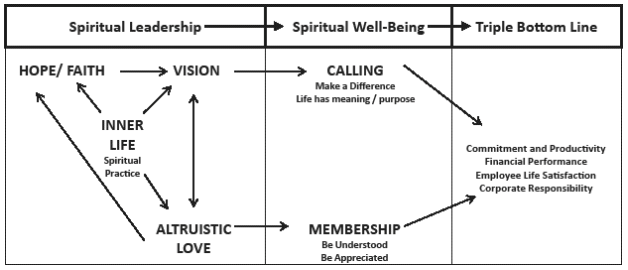
Spiritual leadership aims at increasing the intrinsic motivation of the leader and of the staff members “through vision, hope/faith and altruistic love” (Fry, 2003, p. 719). The triad “vision, hope/faith and love” obviously resembles the triad in the New Testament letter 1 Corinthians 13:13: “And now these three remain: faith, hope and love.” Fry (2003) does not make any reference to this bible verse, but the similarity is too great to be coincidental. Since Fry lives in the US where the bible is part of the culture and 1 Corinthians 13 is often read at weddings, we can assume that Fry was familiar with this bible verse. My assumption is that Fry got his inspiration from this bible verse and modified the triad slightly, but did not mention his source to keep SLT from looking too Christian.
When defining faith, Fry (Fry, 2003, p. 713) starts with Webster’s dictionary: “Faith is the assurance of things hoped for, the conviction of things not seen.” This is a direct quote from the New Testament letter Hebrews 11:1 (English Standard Version). It is interesting to note that again Fry does not mention this source, as already noted by Benefiel (2005, p. 727). “Furthermore, Fry’s definition of faith is taken from a specific religious tradition (Hebrews 11:1), something he himself, in his effort to be inclusive, wants to avoid.” Fry then concludes from this definition: Hope is a desire with expectation of fulfillment. Faith adds certainty to hope (Fry 2003, p. 713 & Nisiewicz, 2013, p. 44).
In addition, Fry’s pluralistic attitude toward religion is remarkable in that he touts several references to the conservative evangelical pastor John MacArthur. With reference to MacArthur (MacArthur, 1998) Fry concludes: People with hope/faith have a vision of where they are going, and how to get there; they are willing to face opposition and endure hardships and suffering, to achieve their goals (Fry, 2013, p. 713).
Indeed, this passage looks like a quotation from a Christian book about discipleship. But in the very next sentence Fry transfers this to the context of organizational leadership: Hope/faith is thus the source for the conviction that the organization’s vision/purpose/mission will be fulfilled (Fry, 2003, p. 713). Almost in preaching style Fry says: “The race of faith is a marathon not a sprint; it requires endurance, perseverance, and a willingness to ‘do what it takes’ one’s personal best and to maximize one’s potential” (Fry, 2003, p.713). The metaphor of a race is again taken from John MacArthur (1998).
As shown by the diagram, SLT starts with the leader. If she/he exercises spiritual leadership living by the three core values of love, hope/faith and vision that will benefit staff members who will then enjoy spiritual well-being. In the end it is good for the whole company and will maximize the triple bottom line, which refers to the three Ps: people, planet and profit (Fry & Nisiewicz 2013).
The following diagram is presented in several publications, showing the overall picture of the SLT:
Figure 1: Model of Spiritual Leadership
Source: (Fry & Nisiewicz, 2013, p. 5; Fry, 2016, p. 4)
Fry’s starting point is quite typical of US American management literature, which focuses on the leader – the leader as a hero. This research paper will not discuss whether his model works. My critique will focus on Fry’s underlying theology and observations are as follows:
- In his first publication (Fry, 2003), religion and theology play a larger role than his later one (Fry, 2016).
- Fry’s choice of theological authors is diverse but also eclectic: the Dalai Lama; Horton, a liberal Christian theologian whose concept is outdated by now, and a right-wing evangelical pastor who condemns religious plurality. It can be doubted whether Fry used the quotations from MacArthur in such a way that would please MacArthur.
- Although Fry claims that SLT is open to any form of spirituality, there are several hidden Christian roots in his approach (Benefiel, 2005, p. 727).
In the next section Fry’s understanding of hope will be analyzed from a theological perspective.
The Virtue of Hope Compared to Fry’s use of Hope
This section summarizes some of the characteristics of hope to critically examine Fry’s understanding of hope. My presentation of hope is based primarily on the monographs of Josef Pieper (Pieper, 1945) and Gabriel Marcel (Marcel, 1951).
The German Catholic theologian Josef Pieper published a small book on the virtue of hope in 1935 during the Nazi-regime in Germany. His theology is grounded in the theology of Thomas Aquinas. Pieper applies this to the modern world. This is why, in my analysis, I focus on Pieper’s treatise and not on his writings. Almost at the same time as Pieper, in January 1942, amidst the sufferings of World War II, the French philosopher and Christian existentialist Gabriel Marcel finished a treatise on the metaphysics of hope, titled “homo viator” (Marcel, 1951, p. 67; term will be explained below). The treatise was only published in 1944 (Röbel & Schüßler, 2021, p. 17). Both monographs, by Pieper and Marcel, were groundbreaking treatments of the virtue of hope in the 20th century and have been well received worldwide. Additionally, Grün (Grün, 2009), Eagleton (Eagleton, 2015), Pinches (Pinches, 2015), van den Heuvel (van den Heuvel, 2020) and Röbel and Schüßler (Röbel & Schüßler, 2021) are addressed in this paper. Each of them refers to Pieper and/or Marcel in various ways.
First and foremost, the virtue of hope is linked to the idea of “homo viator” (Pieper 1949, Marcel, 1951). “Homo viator” means “human being on the way, on a journey.” It is linked to the old and now rediscovered metaphor of the pilgrimage. Thus, hope is the virtue of the “not yet” (Pieper, 1949, p.22, quoted in Wald 2021:54). The “not yet” of the status viatoris includes a negative and a positive: the non-being of fulfilment and the direction of fulfilment (Pieper, 1949, p. 13-14).
Thus, hope is process oriented. “He who hopes … seems to himself to be involved in some kind of process” (Marcel, 1951, p. 35; also quoted in Michener, 2020, p. 85).
Secondly, hope is an open process. According to Marcel (Marcel, 1956, p. 36), one can only speak of hope “when the temptation to despair exists.” “Hope is the act by which this temptation is actively or victoriously overcome” (Marcel 1956, p. 36; also quoted in Michener, 2020, p. 86). Pleeging and Burger (Pleeging & Burger, 2020, p. 172) point out that hope includes “the inherent uncertainty of whether or not we will attain our hopes” and how to deal with this uncertainty. As an implication, hope should not be too concrete: Hoping does not mean clinging to something concrete, such as the cure of a disease. Rather, to hope means to go beyond my imagination.
This openness becomes very clear in the statement of KJA-LRO (KJA-LRO, 2020), quoted in the section.
The following table summarizes findings on the virtue of hope.
Table 1: Characteristics of Hope
| Six Characteristics of Hope as Virtue |
|---|
| 1. Hope relates to human beings on the way, “homo viator”. |
| 2. Hope is an open process, with despair in sight. |
| 3. Hope is a disposition which has to be developed. |
| 4. We hope for things we cannot achieve alone. |
| 5. The object of biblical hope is beyond earthly life. |
| 6. The object of biblical hope is known only by divine revelation. |
The Virtue of Hope Compared to Fry’s use of Hope
This section summarizes some of the characteristics of hope to critically examine Fry’s understanding of hope. My presentation of hope is based primarily on the monographs of Josef Pieper (1945) and Gabriel Marcel (1951).
Thirdly, hope must clearly be distinguished from optimism. On the surface, hope and optimism might look similar. Marcel examines at length “the difference between hope and optimism” (Marcel, 1951, p. 33). Marcel argues that hope is a virtue, to be trained (Marcel, 1951, p. 63). The optimist is he who has a firm conviction, or in certain cases just a vague feeling, that things tend to “turn out for the best” (Marcel, 1951, p. 33).
The Benedictine monk Anselm Grün (2009, p. 131), Germany, refers to Marcel’s distinction and continues by explaining that the hopeful person is involved in a process of becoming. Eagleton (2015) published a monograph on the crucial distinction between hope and optimism. In his opening chapter titled, “the banality of optimism”, Eagleton explains the fundamental difference between optimism and hope. Unlike hope, optimism is not a virtue … not a disposition one attains through deep reflection or disciplined study. It is simply a quirk of temperament. ‘Always look on the bright side of life’ (Eagleton, 2015, p. 2). Eagleton would agree to Marcel’s assumption that “such a thing as deep optimism does not exist” (Marcel, 1951, p.34).
Next, we hope for things which we cannot achieve alone. To hope means: to hope for something from someone. We hope for what is not possible for ourselves. What we can do ourselves, we do not hope for” (Wald, 2021, p. 62).
These four characteristics of hope are in obvious contrast to Fry’s understanding of hope: Hope/faith is thus the source for the conviction that the organization’s vision/purpose mission will be fulfilled (Fry, 2003, p. 713).
In his definition hope/faith is the conviction that we will achieve by the stated goals of our own power. Then hope becomes something manageable. This managerial approach is visible in figure 1. It creates the impression that spiritual leadership with the ingredients of hope/faith, vision and love will automatically lead to spiritual wellbeing of the staff members and that will automatically lead to more productivity and then to more profit. This is close to the religion of positive thinking, which Fry himself clearly states. SLT assumes that “organizations are responsive to positive thought” (Fry, Vitucci & Cedillo, 2005, p. 851).
In addition to these four observations on the principle of hope as such, two theological statements must be added. Fifthly, the object of biblical hope is beyond earthly life. According to Thomas’ classification, hope is a theological virtue, and “like all theological virtues its object is God” (Pinches, 2015, p. 349). As pointed out by Alford and Naughton (2001, p. 217), a Christian perspective must refer “to our ultimate end” which is beyond our earthly life.
Lastly, we only know about the object of hope by divine revelation. Since the object of hope transcends our earthly life, its content must be revealed from outside. The Old Testament narrative Jeremiah 28-29 mentioned in the introduction may illustrate some of these features: The false prophet Hananiah was optimistic: “We will return within two years”. The prophet Jeremiah had to announce that the return would not happen before the end of 70 years. This prophecy was given by divine revelation (no. 6). The hope referred to something which was beyond the earthly lives of the readers (no. 5). The people in the exile hoped for a return which they could not achieve alone; God had to interact (no. 4). The people in the exile were discouraged, they needed encouragement so that their hope could be developed (no. 3). When the prophecy was uttered, it was unclear what the return would look like in concrete terms (no. 2). Obviously, the people in the exile were on the move, looking for a return (no. 1).
The characteristics of Table 1 show that the biblical concept of the virtue of hope cannot be secularized in the end. Pieper was convinced that hope is either a theological virtue or not a virtue at all (Pieper, 1949, p. 25, quoted in Pinches, 2015, p. 16). I would argue that even within a secular worldview, hope can be seen as a virtue with the first four characteristics listed above. But I would agree that the full meaning of hope can only be grasped if one sees it as a theological virtue.
Since Fry wants to keep his SLT open for all sorts of religion and spirituality, it is understandable that he does not include items five and six. But even if we leave out these two divine aspects, it becomes clear that Fry’s understanding of hope is very different from that of Pieper, Marcel, and Eagleton. What Fry calls “hope” should rather be called “optimism”, but then, of course, the link to spirituality would vanish.
Two Catholic Examples
This section presents two examples of integrating hope into a leadership frame. They are not as famous as Fry’s concept. But I think that these approaches stick much closer to the biblical teaching on hope than Fry’s approach. In both cases the authors are Catholic authors and build on the Catholic teaching on hope as virtue. These examples show that it is possible to integrate the biblical teaching on hope within a leadership concept.
Alford and Naughton
In 2001 the two Catholic authors Helen Alford O.P. of the Pontifical University of Saint Thomas, Rome and Michael Naughton of the University of Saint Thomas, Minnesota published a book with the programmatic title Managing as if Faith Mattered (Alford & Naughton, 2001). As the subtitle declares, the goal is to apply Christian social principles within the modern organization. Noting the “awakening” of spirituality at work in the late 1990s, Alford and Naughton wanted to offer a “Christian spirituality at work” (Alford & Naughton, 2001, p. 207), “connecting the richness of one religious tradition – the Christian social tradition – with management theory and practice” (p. 2-3).
This is done in three steps: “Establishing the engagement” (part 1), “Making the engagement” (part 2), and “Sustaining the engagement” (part 3). The third part starts with discussing the three theological virtues faith, hope, and charity (chapter 3). The section on hope is a bit more than three pages (pp. 217–220).
According to Alford and Naughton, hope offers an answer to the question “Where am I going?” (p. 217). They take up the teleological aspect of hope: “a Christian spirituality of work would be deficient, even fundamentally incomprehensible, without reference to our ultimate end” (p. 217). The Christian concept of hope looks beyond death and thus protects against two opposing errors. On the one hand, “we must never overinvest ourselves in work, as if it could bring us to our full completion” (p. 217). On the other hand, “we must never underinvest ourselves in work” (p. 218). “(Hope) does give us the courage to attempt great things that hint at the greatness for which we have been made. We overcome cynicism and its root of despair through the daily habit of hope. To hope is to rest in God’s assurance that all will be well” (p. 219). Alford and Naughton conclude that hope has a balancing effect: “Hope prevents us from both overrating and undervaluing work” (p. 220).
Catholic Youth Agencies
The Katholische Jugendagenturen (Catholic Youth Agencies) are five nonprofit organizations that provide pastoral and social care to youth within the Archdiocese of Cologne, Germany. They run facilities and projects in child and youth work, youth social work, educational assistance, and several others. One of them is the Katholische Jugendagentur Leverkusen, Rhein-Berg, Oberberg, and KJA LRO consisting of 450 full-time employees working in 55 institutions and projects (KJA LRO, 2024). In 2020 KJA LRO released an internal paper “principles of action” for the whole staff (KJA LRO, 2020).
Page three specifically addresses staff members in leadership positions. Under the heading “Orientation to the leadership principles of the Bible,” five principles are listed. The first four are taken from Kessler (2019): Leading by serving, leading with power, leading with responsibility, leading out of and with forgiveness (KJA LRO, 2020, p. 3). In addition, they added a fifth principle, not in Kessler’s book: Leading with hope means that we trust that our (leadership’s) actions will lead to something positive. We try to act with confidence, especially in situations that at first seem hopeless.
This addition of hope as a fifth principle is important and helpful. As a youth agency, staff members often deal with children and young people from very difficult social backgrounds. These situations often seem hopeless, making it even more important to refer to hope. The phrase “something positive” sounds vague, but seems appropriate in this context. Even if there are small signs of hope, one never knows how it will be fulfilled.
When asked about the motivation for integrating this principle, CEO Thomas Droege responded: “Hope has been explicitly added because I see the principle of hope as an essential characteristic of the Christian faith, which is also explicitly named in 1 Corinthians 13 ‘Faith – Hope – Love’.” It is evident that their definition of leading with hope fits very well with the Christian perspective on hope, although it makes no explicit reference to God or eternity, unlike the book by Alford and Naughton (2001).
Summary
In conclusion, pertaining to five observations: First and foremost, the long-term crises over Covid-19 have reminded us that hope is essential for leadership. Secondly, the good thing about Fry’s SLT is that he at least tries to integrate hope in a leadership concept. Unfortunately, his concept of hope lacks depth (third observation). Although Fry (2003) starts with Bible verses, he ends up with a superficial understanding of hope, more in the understanding of optimism.
Compared to the richness and depth found in the understanding of hope as a virtue, Fry’s definition sounds banal and trivial. Luckily, hope understood as a virtue has a long, rich tradition on which we can build (fourth observation). Table 1 demonstrates the differences between hope and optimism. The main difference is probably that hope is an open process and not a fixed image of the future.
The characteristics in Table 1 demonstrate that, in the end, the biblical concept of the virtue of hope cannot be secularized. By secularizing the concept of hope, it will lose its depth and most probably become transformed into banal optimism. On an ending note, the Catholic perspectives of Alford and Naughton (2001) and KJA-LRO (2020) provide good examples of how the biblical concept of hope can be integrated into a leadership concept.
References
Alford, H. J. & Naughton, M. (2001). Managing as if faith mattered: Christian social principles in the modern organization, University of Notre Dame Press, Notre Dame.
Benefiel, M. (2005). The second half of the journey: Spiritual leadership for organizational transformation. The Leadership Quarterly 16, 723-747.
Böke, E. (2022). Spiritual Leadership am Arbeitsplatz: Ein Vergleich der Spiritual Leadership Modelle von Louis Fry und Anselm Grün. [Master’s dissertation, University of South Africa].
https://uir.unisa.ac.za/bitstream/handle/10500/29238/dissertation_boke_e.pdf?sequence=1&isAllowed=y
Cerff, K., & Winston, B. E. (2006). The inclusion of hope in the Servant Leadership model. Regent University.
https://www.semanticscholar.org/paper/The-Inclusion-of-Hope-in-the-Servant-Leadership-Cerff-Winston/…
Comte-Sponville, A. (2008). Woran glaubt ein Atheist? Spiritualität ohne Gott. Diogenes.
Droege, T. (2022). Personal mail to the author, dated May 3, 2022.
Eagleton, T. (2015). Hope without optimism. Yale University Press, kindle-version.
Fry, L.W. (2003). Towards a theory of spiritual leadership. The Leadership Quarterly 14, 693–727.
Fry, L.W. (2005). Introduction to the leadership quarterly special issue: Toward a paradigm of spiritual leadership. The Leadership Quarterly 16, 619–622.
Fry, L.W. (2016). Spiritual Leadership. In A. Farzmand (Ed.). Global encyclopedia of public administration, public policy, and governance (pp. 1-6). Springer.
Fry, L.W. & Nisiewicz, M.S. (2013). Maximizing the Triple Bottom Line Through Spiritual Leadership. Stanford Business Books.
Fry, L.W., Vitucci, S. & Cedillo, M. (2005). Spiritual leadership and army transformation: Theory, measurement, and establishing a baseline. The Leadership Quarterly 16, 835–862.
Grün, A. (2009). Führen mit Werten: Ethisch handeln – Herausforderungen bewältigen. (3. Aufl.) Olzog.
Hellend, M. & Winston, B. (2005). Towards a deeper understanding of hope and leadership. Journal of Leadership and Organizational Studies 12(2), 42-54.
Horton, W. R. (1950). God (9th printing). Association Press.
Kessler, V. (2019). Vier Führungsprinzipien der Bibel: Dienst, Macht, Verantwortung und Vergebung (2. Aufl.) Brunnen.
KJA LRO (2020). Handlungsgrundsätze der KJA LRO, retrieved August 31, 2020, internal paper.
KJA LRO (2024). Katholische Jugendagentur Leverkusen, Rhein-Berg, Oberberg, retrieved June 5, 2024, from
https://kja-lro.de.
Kraft, A. M. & Walker, A. (2018). Positive Psychologie der Hoffnung. Grundlagen aus Psychologie, Philosophie, Theologie und Ergebnisse, aktuelle Forschung. Springer.
Luthans, F. & Avolio, B. J. (2003). Authentic leadership: A positive leadership development, In K. S. Cameron, J.E. Ducron & R. E. Quinn (Eds.), Positive Organizational Scholarship, (pp. 241-258), Berrett-Koehler.
Luthans, F., van Wyk, R. & Walumbwa, F. O. (2004). Recognition and development of hope for South African organization leaders. The Leadership and Organizational Development Journal 25(6), 512-517.
MacArthur, J. F. (1998). In the footsteps of faith, Crossway.
MacArthur, J.F. (2013). The MacArthur study bible, Thomas Nelson Publishers.
Marcel, G. (1951). Homo viator, introduction to a metaphysic of hope. Henry Regnery.
Michener, R. (2020). Post-Kantian to Postmodern Considerations of (Theological) Hope. In S. van den Heuvel (Ed.), Historical and multidisciplinary perspectives on hope (pp. 77-98). Springer.
Pieper, J. (1949). Über die Hoffnung (5. Aufl.). Kösel.
Pinches, C. (2015). On hope. In K. Timpe & C. Boyd (Eds.), Virtues and their vices (pp. 349-368). Oxford University Press.
Pleeging, E. & Burger, M. (2020). Hope in Economics. In S. van den Heuvel (Ed.), Historical and multidisciplinary perspectives on hope (pp. 165-178). Springer.
Röbel, M. & Schüßler, W. (Eds.) (2021). Der Mensch als “homo viator”. Existenzphilosophische Perspektiven. Karl Alber, Freiburg.
Van den Heuvel, S. (Ed.), 2020. Historical and multidisciplinary perspectives on hope, Springer.
https://doi.org/10.1007/978-3-030-46489-9.
Wald, B. (2021). Viatorische Existenz. Grundlegung einer Philosophie der Hoffnung bei Josef Pieper. In M. Röbel & W. Schüßler (Eds.). Der Mensch als “homo viator”: Existenzphilosophische Perspektiven, (pp. 49-73), Karl Alber.
Wingfield, M. (2021). Neither democracy nor religious freedom are biblical concepts, John MacArthur declares. Baptist News Global, February 1, 2021, retrieved August 10, 2022, from
https://baptistnews.com/…/john-macarthur-declares/.
Yang, M. & Fry, Louis W. (2018). The role of spiritual leadership in reducing healthcare worker burnout. Journal of Management, Spirituality & Religion, 15(4), 305–324.